From AI Week to Your Degree: Shaping What Comes Next at Tel Aviv University
Discover international undergraduate and graduate programs where research connects knowledge to action


Each year, AI Week and Cyber Week bring global researchers, industry leaders, policymakers, and students to Tel Aviv University to explore how artificial intelligence and cybersecurity are reshaping the world.
This year’s events highlighted something even more significant: the way these technologies cut across disciplines, from neuroscience and medicine to creativity, business, law, and global policy.
At TAU, research leads the conversation, and ideas move from theory to real-world impact.
As applications open for TAU’s international programs, the insights shared during AI Week and Cyber Week offer a glimpse into the academic environment students can join.
AI Is Changing How We Understand the Human Brain
One of the most striking sessions at AI Week examined how the brain responds differently to human versus AI-generated music. Dr. Neta Maimon, a TAU neuroscientist and accomplished cellist, showed how listening shifts the brain between states of alertness, focus, and creative drift.
Her key insight was both scientific and intuitive: AI-generated music is often too polished.
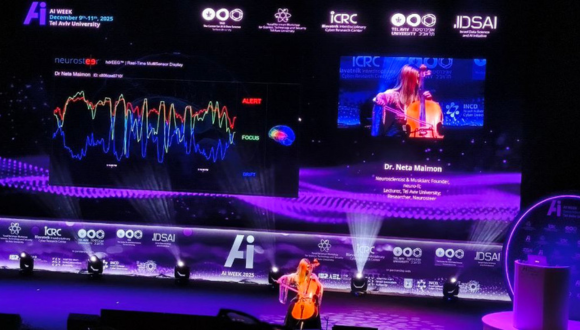
Dr. Neta Maimon presenting at the AI Week 2025.
Without the subtle variations introduced by human performers, the brain works harder to stay engaged. To make this tangible, Dr. Maimon projected her brain activity live while performing a cello piece, offering a vivid illustration of how neuroscience, creativity, and AI intersect.
Study It at TAU
- MSc in Neuroscience: Hands-on training in neuroimaging, EEG, fMRI, and computational modeling. Students work in TAU’s interdisciplinary labs and in hospitals affiliated with the university.
- MSc in Medical Sciences: For students interested in the biological and clinical foundations of brain research, with opportunities for hospital-based and lab-based projects.
Medicine Is Becoming Data-Driven, Interdisciplinary, and AI-Powered
AI & Health Day focused on how artificial intelligence is transforming diagnostics, clinical decision-making, and translational research, with a strong emphasis on responsible pathways from academia to industry.
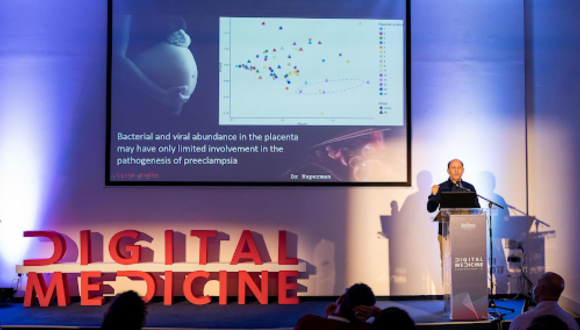
Prof. Shomron is an expert in expert in gene expression and translating data for clinical settings
Prof. Noam Shomron, Head of TAU’s Digital Medicine Research Team and Academic Head of the MSc in Digital Health, presented AI-driven approaches to biopsy diagnostics and clinical decision-support systems.
Biomedical innovation was further represented by Dr.Eric Shifrut, TAU Assistant Professor at Tel Aviv Sourasky Medical Center, whose research on CRISPR discovery platforms bridges computational biology and immunotherapy.
TAU students in the medical sciences benefit from close collaboration across research labs, affiliated hospitals, and industry partners
Study It at TAU
- MSc in Digital Health: Applied AI in healthcare systems and clinical environments.
- MSc in Biomedical Engineering: Imaging, diagnostics, signal processing, and medical devices.
- MSc in Medical Sciences: Translational research in affiliated hospitals and labs.
Creativity and AI Are Not Opposites—They Are Collaborators
The Future of Creativity in the Age of Generative AI panel brought together musicians, producers, technologists, and legal experts to examine how AI is reshaping artistic work.
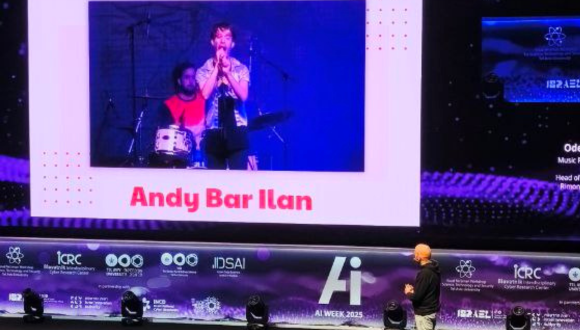
Oded Davidov showed how voice generation tech helped Andy Bar Ilan from Rimon School of Music, a talented musician whose disability affects his ability to speak and sing, record an album in his own voice.
Panelists spoke about creativity as an inherently human process, where AI serves as a tool for experimentation, access, and expansion. Demonstrations showed how AI-assisted music production can support artists with physical limitations and open new creative pathways.
One recurring idea stood out: the “spark” behind creativity cannot be automated, but it can be supported.
Study It at TAU
- BA in Liberal Arts: Tracks in Literature, Philosophy, and Digital Culture.
- MA in English Literature & American Studies: Examining culture, narrative, and meaning-making in a digital age.
- MFA in Documentary Cinema: Exploring storytelling, ethics, and technology through visual media.
Entrepreneurship Is Becoming AI-Native
Alongside AI Week, the Startup Exhibition brought together startups from across the ecosystem, including the Coller Startup Competition, which supports student- and alumni-led ventures at early stages. The exhibition reflects TAU’s broader entrepreneurial impact: ranked #1 globally among non-US universities for producing unicorn founders.
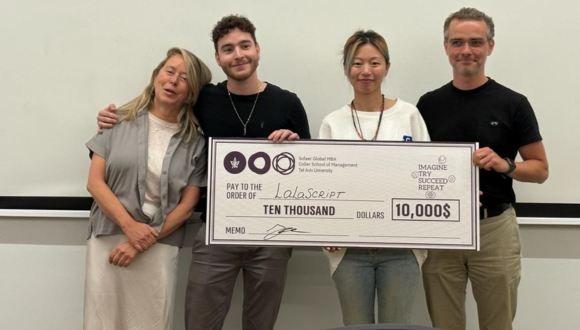
The winning team of the Sofaer Global MBA startup competititon with Prof Jackie Goren (left): Ohad Gev, Liu Liu, and Ilya Kolin (left to right)
Insights from the competition emphasize a practical shift in AI-driven entrepreneurship, where success depends less on standalone tools and more on integrating large AI models strategically. As the competition representative put it, “it’s not a question about prompts, but how to leverage AI to achieve your goals.”
Study It at TAU
- Sofaer Global MBA: Strategy, innovation, and direct engagement with Israel’s startup ecosystem
- Coller Deep Tech MBA: Designed for founders and professionals working at the intersection of advanced technology, AI, and commercialization
- BA in Management and Liberal Arts: Including entrepreneurship-focused pathways
- Engineering degrees: Strong industry ties and applied research opportunities
AI, Cybersecurity, and Society Are Deeply Intertwined
The Cyber Week turned the campus into a global hub for discussions on cybersecurity, disinformation, AI governance, and national resilience. Sessions examined how AI reshapes threat models, public discourse, and legal responsibility.
Panels on online disinformation, AI and law, and critical infrastructure explored how societies can balance innovation with accountability. A shared theme across both weeks was trust: how to build it, protect it, and regulate systems that increasingly shape public life.
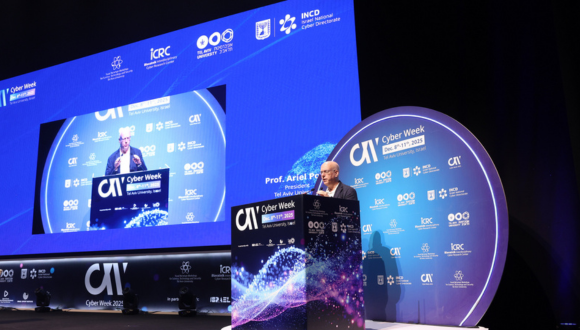
Prof. Ariel Porat, President of Tel Aviv University, speaking at the main plenary session of the Cyber Week 2025 (Photo credit: Chen Galili)
Research presented by TAU’s Prof. Wasim Huleihel illustrated how algorithms influence beliefs and how statistical tools can audit these effects, a clear example of how engineering and social science intersect at TAU.
Study It at TAU
- MA in Cyber Politics & Government: Cyber strategy, governance, and digital influence.
- MA in Security & Diplomacy: Global threats, technology, and policy formation.
- MA in Conflict Resolution: Including the study of disinformation, media manipulation, and regional conflict.
- Jewish Studies MA: Offering historical, textual, and cultural perspectives essential for understanding identity, narrative, and misinformation in contemporary discourse.
- Parasol LL.M. (Law & Technology track): Regulation, ethics, intellectual property, and digital rights.
Global Challenges: Climate, Policy, and Data-Driven Decision-Making
Discussions during AI Week and Cyber Week also pointed to a broader reality: many of today’s most urgent challenges, from climate change to social resilience, are increasingly shaped by data, modeling, and policy decisions informed by technology.
AI tools now support climate modeling, environmental risk assessment, and public policy planning, while questions of equity and governance remain central.

Alexa Goldner, graduate of Sustainable Development MA, with students of Nakuru High School in Kenya.
Study It at TAU
- MA in Environmental Studies: Combining environmental science, sustainability, and policy analysis, with a strong focus on real-world challenges.
- MA in Social Policy of Climate Change: Examining how governments, institutions, and societies respond to climate risk, environmental justice, and global policy frameworks.
- MA in Sustainable Development: An interdisciplinary program exploring the social, economic, and policy dimensions of sustainability in a global context.
Where Technology Is Built: Engineering at the Core
Many of the breakthroughs presented during AI Week, from medical imaging and computational genomics to AI-driven diagnostics and cybersecurity, are rooted in engineering research. At Tel Aviv University, this work begins at the undergraduate level.
Study It at TAU
- BSc in Mechanical Engineering: Strong foundation in mechanical systems, robotics, materials, and applied engineering, with early exposure to research, laboratories, and industry-linked projects.
- BSc in Electrical Engineering: Focused on electronics, signal processing, communications, and systems that underpin AI, medical technologies, and cybersecurity.
Both programs offer olim integration tracks, allowing students to begin in English and gradually transition to Hebrew, supporting integration into Israel’s academic environment, local job market, and startup ecosystem.
Why This Matters, and Why TAU
Across AI Week and Cyber Week, one message emerged clearly: at TAU, the future of AI touches every discipline across the university.
Tel Aviv University's strength lies in addressing that reality through research leadership, interdisciplinary programs, and real-world engagement.
International students at TAU gain:
- access to leading researchers and extensive lab infrastructure
- opportunities to work in affiliated hospitals and research centers
- exposure to global conversations through major campus events
- degree programs that reflect how technology actually shapes society
Applications Are Now Open
Whether your interests lie in neuroscience, healthcare innovation, engineering, creative technologies, entrepreneurship, cyber policy, or diplomacy, Tel Aviv University offers the academic foundation to shape what comes next.
Explore TAU’s international programs and apply today.
FAQ
Who are TAU’s international programs designed for?
TAU’s international programs are designed for students who want a research-led education with real academic depth and practical relevance. Programs suit students interested in AI, engineering, health, neuroscience, social sciences, policy, business, humanities, and global challenges.
Do I need a technical background to study AI-related topics at TAU?
Not necessarily. While engineering and science degrees focus on technical foundations, many AI-related topics are explored through social sciences, humanities, law, business, and policy programs. TAU emphasizes interdisciplinary learning across fields.
Which degrees are available in English?
Tel Aviv University offers a wide range of English-taught undergraduate and graduate programs, including degrees in Engineering, Neuroscience, Digital Health, Biomedical Engineering, Business (MBA), Cyber Politics & Government, Security & Diplomacy, Conflict Resolution, Environmental Studies, Jewish Studies, Literature, Film, and more.
Some programs also offer integration tracks that begin in English and gradually transition to Hebrew.
Can undergraduate students study engineering at TAU?
Yes. International students can apply to BSc programs in Mechanical Engineering and Electrical Engineering, both of which offer olim integration tracks. These tracks support students who are new to Israel by starting in English and integrating into Hebrew-taught courses and the local job market over time.
Do TAU students gain hands-on experience during their studies?
Yes. Students benefit from access to research labs, affiliated hospitals, industry partnerships, startup initiatives, and major campus events such as AI Week and Cyber Week. Many programs include research projects, applied coursework, and internships
Can international students work or intern during their studies?
Opportunities vary by program and visa status, but many students engage in research assistant roles, internships, and industry-linked projects during their studies, particularly in engineering, health sciences, business, and policy programs.
How do I apply to Tel Aviv University as an international student?
Applications are submitted online through TAU’s international admissions portal. Each program page includes admission requirements, deadlines, and contact details for program advisors. You can start your application by filling in the form here.
Where should I start if I’m not sure which program fits me best?
Start by exploring TAU’s international undergraduate and graduate programs by field of interest. Admissions teams and program coordinators are available to help you identify the best academic path based on your background and goals.
Related Articles