A Rare Seat at the Table: TAU Student Joins the Arab-Mediterranean Campus in Italy
“I came with a very open mind to get to know the people and hear their perspectives”


TAU undergraduate Amit Shmueli joined the Arab-Mediterranean Campus (AMC) in Italy, studying alongside peers from across the Middle East and North Africa, including countries that rarely interact directly with Israelis.
As the only Israeli participant, Shmueli engaged in candid conversations about identity, religion, and regional realities, often in Arabic, discovering that personal encounters can challenge assumptions on all sides and build understanding even amid deep disagreements.
Tel Aviv University offers a wide range of outgoing exchange opportunities to undergraduate and graduate students.
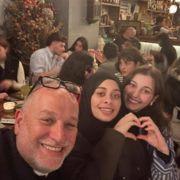
An Israeli student sitting in a classroom alongside peers from Libya, Lebanon, Iran, Iraq, Turkey, Morocco, and the United Arab Emirates is not a common sight. Yet this was precisely the setting of the Arab-Mediterranean Campus (AMC) in Italy, where Amit Shmueli, a third-year Tel Aviv University undergraduate, joined students from across the Middle East and North Africa for a shared academic experience designed to encourage dialogue across borders.
Majoring in Middle Eastern Studies, Amit Shmueli was immediately drawn to the program’s international character: "I saw that it is a program in Italy designed for students from all over the Middle East, from Morocco to Iran, and focused on the topics that interest me, Middle East, global challenges, and public policy. It was an opportunity to enrich myself and to study in English at a university abroad."
“I came with a very open mind, and I came to get to know the people. One of the goals of the program is that there will be dialogue between the students.”
What Is the Arab-Mediterranean Campus?
A collaborative initiative of 12 Italian universities, the Arab-Mediterranean Campus explored topics ranging from political science and international relations to AI, food security, and the Middle East's relationship with Europe.
The program unfolded in two stages, beginning with an online learning phase. The highest-scoring students were then invited to the in-person stage in Italy, where over two intensive weeks they attended courses on the Luiss Campus in Rome and also in Naples.
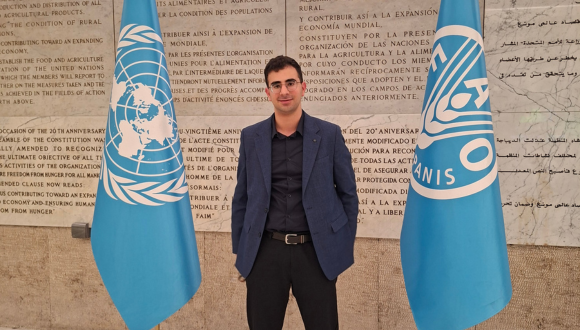
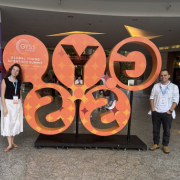
Amit Shmueli at the offices of the UN Food and Agriculture Organization (FAO).
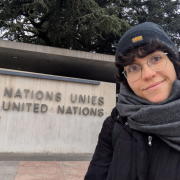
In addition to academic courses, participants visited institutions such as the Italian Ministry of Foreign Affairs and the United Nations Food and Agriculture Organization (FAO), meeting policymakers and experts working on global challenges.
Amit Shmueli was the only participant from Israel who travelled to Italy for the in-person program. For him, the most significant learning often happened outside the lectures, in conversations with fellow students.
Going in with Eyes Open
Before leaving for Italy, Shmueli met with Galia Netzer-Erlichmen, Head of the Internationalization at Home at the TAU’s Lowy International School, to discuss the unique nature of the program and the kinds of situations he might encounter. The meeting was part of the preparation sessions regularly organized by the Lowy International School for TAU students participating in exchange programs.
The conversation focused on practical guidance: navigating sensitive political discussions, responding to difficult questions, and approaching interactions thoughtfully.
“The session helped me think in advance about how to react. What people might ask, how to answer questions, what to say, and also what maybe not to say. You have to know how to deal with situations there.”
Netzer-Erlichmen also prepared him for the possibility that, as the only Israeli participant, he might find himself on his own in conversations or group activities. As Shmueli recalls, “Yes, there were moments like that. But that’s okay. I felt comfortable and safe.”
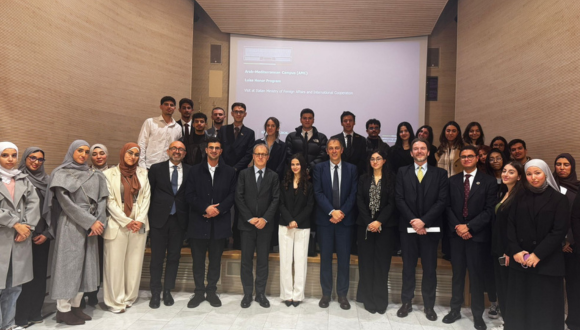
Participants of the Arab-Mediterranean Campus program met with Italian diplomats at the Italian Ministry of Foreign Affairs.
Having space to think through these possibilities beforehand helped him approach the program with both confidence and awareness.
“You come there as yourself, but you also represent something bigger.”
One Israeli, Many Conversations
For many in the group, this was their first direct interaction with an Israeli student. Shmueli was conscious of the significance of that. "I was the only Israeli, so of course it forces you to try and connect, and I did the maximum. I said: ‘Whoever wants to talk is welcome, whoever doesn't, I can't force it,’" Shmueli says.
“There were people who talked to me freely and wanted to know things.”
Others were interested in conversation but felt constrained by political realities in their home countries. In some cases, group dynamics also played a role. “There were also those who simply did not want to talk,” he says.
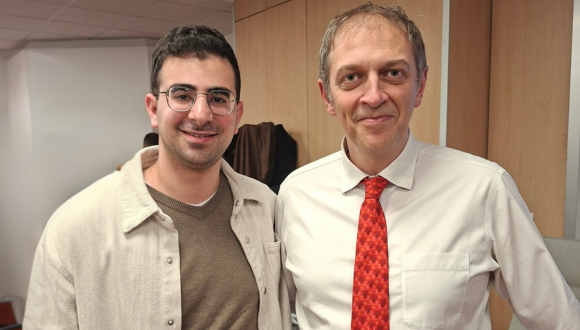
Amit Shmueli (left) with the Director of the Arab-Mediterranean Campus program, Prof. Raffaele Marchetti.
Personal meetings did not erase political differences, nor were they meant to. “You sit and talk because you never actually sit down and talk to those people,” Shmueli explains. “And suddenly you discover things about them, and they discover things about you.”
Language was another bridge. Because Shmueli speaks fluent Arabic, he could communicate with fellow participants in their native language.
“When you show people that you know their language, they really like it and they talk to you.”
“There were a lot of conversations about Judaism and Islam,” he recalls. “We saw many times that there is sometimes similarity between Jews and Muslims.”
“At the end, everyone returns to their country. But maybe someone will say… I met an Israeli and he is not like what I thought.”
Shmueli believes the exchange works both ways. “When I return home, I can also say: I met people from Libya or Syria, and they are not what we sometimes imagine either.”
Learning from the People, Not the Page
For someone studying the Middle East academically, meeting peers from across the region brought his field of study to life in ways no textbook could replicate.
“From each of participants you learn something… everyone enriches you in one way or another,” says Shmueli. “You hear about their daily lives, their universities, what is happening in their countries, and you understand the region differently.”
“The personal meetings there were no less fascinating than the courses we had.”
Some discussions directly challenged assumptions formed through academic study. 'We're very used to learning about Syria's minorities and religious divisions, how significant they are,' Shmueli explains.
'But when a Syrian student told me about daily life there, he said ‘It’s not like we walk around all day thinking, this person is Kurdish, this one is Druze, this one is Alevi.’ Of course, these identities exist and they matter, but in daily life people also see themselves simply as Syrians.”
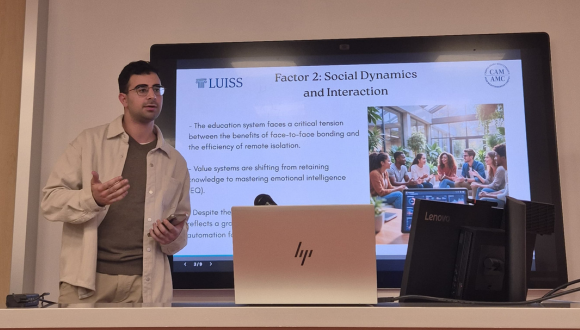
Amit Shmueli presenting during one of the Arab-Mediterranean Campus study sessions at LUISS in Rome.
The same was true for countries covered less frequently in Shmueli’s coursework. "Hearing about life in North African countries like Libya, Tunisia, Morocco was very interesting and important."
Shmueli also learned about the fears and constraints some of his fellow participants experience in their own societies. "You meet people who say, 'We don't have freedom of expression in our country,'" he says. "One student told me how afraid he was even to speak openly about certain topics."
“You hear how people themselves experience their society. It gives you another picture of the situation.”
Moments like this added nuance to the frameworks studied in class. Importantly, the gaps ran in both directions. Some exchanges revealed how little people across the region know about one another.
“Someone asked me why only Jews live in Israel. I explained that there are also Muslim Arabs, Christian Arabs, Druze, Circassians. Many communities living together. They were surprised and said 'we didn’t know that'.”
In another conversation, a Syrian student described how he had only recently discovered that Syria once had a large Jewish community.
“He told me he asked his mother if she knew there was a Jewish community in Syria. She said: ‘Yes, I had a Jewish doctor.’ And he suddenly realized that an entire world had been hidden from him," Shmueli recalls.
"Suddenly you see that there's a person behind the news. It breaks fences."
A Conversation Worth Having
Tel Aviv University's support throughout the process made it possible for Shmueli to participate not just logistically, but with the awareness and tools to engage meaningfully. Such investment reflects a broader commitment to international engagement at the university: sending students into complex, real-world settings where their field of study becomes lived experience.
Looking back, Shmueli strongly encourages other students to pursue opportunities like the Arab-Mediterranean Campus.
“I definitely recommend it. It’s a fascinating experience, and it’s something that doesn’t happen in a regular exchange.”
At the conclusion of the program, he shared that sentiment directly with the other participants. "I told them how happy I was that we had the opportunity to talk to each other," Shmueli says.
For students interested in international relations, regional studies, or diplomacy, programs like the Arab-Mediterranean Campus offer a chance to uncover the Middle Eastern region through direct human interaction rather than through headlines and social media.
“Even if you disagree on many things, the fact that you spoke and listened matters.”
Enrolled at TAU and interested in taking your studies abroad?
Explore exchange opportunities available to Tel Aviv University students and submit your application.
Related Articles