One Degree. Three Tracks. Real-World Impact from Day One
Tel Aviv University's renewed MA in Environmental Studies launches this year, built for the way sustainability careers work today.


TAU is launching a renewed MA in Environmental Studies
English-taught | 1 year | Internship included
Specialization tracks:
Environmental Entrepreneurship | Sustainable Development | Climate Change Policy
Students gain applied experience through field projects, NGOs, municipalities, start-ups, and international initiatives.
Graduates join a global network working across NGOs, government, consulting, international organizations, and the private sector.
Register for the program webinar
May 19, 2026 | 7 PM
Marking Earth Day this year, Tel Aviv University is launching a renewed MA in Environmental Studies as a single home for three existing tracks: sustainable development, climate change, and environmental entrepreneurship & management. Delivered in English across three semesters, the degree is designed for students who want to become environmental leaders advancing real-world solutions.
A joint initiative of the New Environmental School and the School of Social and Policy Studies, the program connects environmental challenges to the social, economic, and political systems that shape them. Students examine how policy, governance, and human behavior interact with environmental processes, and develop practical approaches moving from idea to regulation to funding to on-the-ground implementation.
The renewed Environmental Studies graduate program is led by Professor Alon Shepon, a food systems expert and environmental scientist whose work focuses on the links between nutrition, ecology, sustainability, and policy. Shepon heads the Food and Sustainability Lab at Tel Aviv University and chairs the Israeli Forum for Sustainable Nutrition.
A Multidisciplinary Approach, Backed by Experience
Prof. Noga Kronfeld-Schor, Rector of Tel Aviv University and former Head of the New Environment School, explains the vision behind the initiative: "The environmental field is deeply complex and demands a multidisciplinary approach. Our vision is to harness Tel Aviv University’s diverse expertise to address these challenges head-on."
"We are at a critical juncture where academic knowledge is essential to building a better future. This new master’s program will serve as a global hub, translating scientific research into tangible policy and action for decision-makers, educators, and the public."—Prof. Noga Kronfeld-Schor
The program builds directly on the work TAU has been doing in the field for years. In sustainable development, the Nitsan Lab field-tests Israeli agriculture, water, and energy solutions in real conditions, with active projects that include community water-quality pilots in Tanzania, India, and Brazil, and solar rooftops for off-grid households in Rwanda.
The New Environmental School adds a broad applied research base, from environmental bioengineering and food sustainability to plant ecology, environmental materials, future mobility, industrial ecology, and student-led research. Its EcoBuilding also reflects this approach in practice: Israel’s first LEED Platinum-certified building, with advanced energy and water-saving technologies, a green roof, and graywater-fed biological basins.
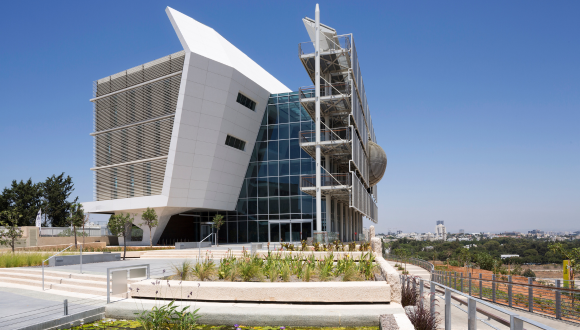
The award-winning Ecobuilding on Tel Aviv University campus, home to the New Environmental School and the Environmental Studies MA
On the climate side, TAU brings long-standing research strength in areas such as regional climate, climate behavior and consumption, urban heat, climate risk, water systems, and ecosystem resilience. Israel's geography is part of what makes this possible.
“Israel's strategic placement in the heart of the Middle East renders it an essential center for comprehending and tackling climate change. Israel has been at the forefront of water technology for decades and has gone from a water-deficient country to a water exporter.”—Ariel Spielman, Environmental Studies MA graduate
A Practical Approach from Day One
Prof. Ram Fishman, Head of the New Environmental School, emphasizes the program’s commitment to real-world application: "As the environmental landscape evolves, our program equips the next generation with the tools to lead and drive meaningful impact for decades to come."
"At our school, tackling the world's most urgent environmental challenges doesn't wait until graduation – it starts the moment you join us. We provide the hands-on experience and expertise currently in high demand, both in Israel and globally."—Prof. Ram Fishman, Head of the New Environmental School
Students get involved in applied work early through field projects, partner organizations, local NGOs, municipalities, and start-ups. Depending on their focus, they may contribute to projects involving water, energy, agriculture, environmental health, communications, product development, or policy.

During her studies at TAU, Alexa Goldner got involved with Engineers without Borders and worked on a spirulina awareness project at Nakuru High School in Kenya
A few examples from recent cohorts:
- Alexa Goldner developed a sustainability campaign that was later adopted by an NGO
- Raziel Hernández Batista combined lab-based research on water systems with broader environmental health work.
- Yuan Zuo collaborated with Ignite in Rwanda on solar home systems for schools in rural areas without electricity, and explored desert farming challenges in Egypt.
- Erica Katzin focused on favela upgrading in Brazil, addressing water, sanitation, education, and housing.
What You Study
The updated Environmental Studies MA curriculum focuses on the major forces driving environmental change today: the climate crisis, pollution, biodiversity loss, ecosystem degradation, and pressure on natural resources. Students work across science, management, economics, policy, law, and behavioral insight, learning how environmental problems are analyzed, translated into strategy, and developed into solutions.
"The professors bring examples from every continent, which makes the learning experience incredibly eye-opening."—Raziel Hernandez Batista, Environmental Studies alumna
By choosing a specialization track, students can shape their degree around one of three paths: green business and entrepreneurship, field-based sustainable development, or climate policy and governance. This structure gives the renewed MA a wider scope than a traditional environmental studies degree, while still allowing students to build a clear academic and professional focus.
A Global Network That Stays With You
Graduates of the former environmental studies, climate change, and sustainable development tracks have gone on to work in international organizations, NGOs, consulting firms, government agencies, and the private sector. Many stay connected through alumni meetups and professional networks.
Students joining the new cohort enter this existing community from the start, gaining access to network already active across sectors and regions.
The program focus is on the complexity and cross-sector judgment that employers in this field consistently look for.
For students looking to enter the environmental field now, the value is in this combination of academic depth, applied projects, and exposure to people and organizations already working on sustainability, climate, development, and policy challenges.
Applications Now Open
Applications are open for the 2026–2027 academic year. For the full curriculum, specialization tracks, admission requirements, and upcoming information sessions, visit the MA in Environmental Studies program page.
FAQ
Does the Environmental Studies MA focus more on science or policy?
The program combines both. Students study environmental systems while also learning how policy, economics, management, law, and human behavior shape environmental decisions and solutions.
Is the Environmental Studies master’s program suitable for students from non-science backgrounds?
Yes. The program is relevant to students from different academic and professional backgrounds, including policy, social sciences, business, development, environmental studies, and related fields.
Is the MA in Environmental Studies suitable for international students?
Yes. The program is taught in English and designed for international students. It combines academic study with applied projects, field-based learning, and exposure to environmental work in Israel and globally.
Related Articles