Inside TAU’s Middle Eastern Studies MA at the Moshe Dayan Center
Study the contemporary Middle East through an English-taught graduate degree that connects historical depth, regional expertise, and applied research.


Study the contemporary Middle East through an applied, historically grounded MA in Middle Eastern Studies program.
Complete the English-taught graduate program in 1 year.
Tuition is $12,640, with scholarships available.
Learn inside the Moshe Dayan Center, which is closely connected to policy, media, and regional dialogue.
Build practical experience through research, language study, events, and internships.
The Moshe Dayan Center for Middle Eastern and African Studies is opening its doors to a new generation of graduate students. The Center's MA in Middle Eastern Studies at Tel Aviv University is built around direct engagement with the region’s languages, institutions, historical memory, and political realities.
At the Dayan Center, that engagement is part of daily work. The researchers who brief policymakers and speak with diplomats also teach courses, supervise internships, and shape the program’s curriculum.
"We are, even more than ever now, in touch with the Middle East, here at the Dayan Center,"—Dr. Brandon Friedman, the academic head of the MA in Middle Easter Studies and the Dayan Center's Director of Research.
Friedman expects that connection to shape the program directly.
Friedman understands the international student perspective firsthand. He came to TAU as an international student, studying the political history of the Persian Gulf, and later built his research career around Gulf politics, Saudi reform, post-Arab Spring state fragmentation, and China’s expanding role in the Middle East. He also serves as Managing Editor of Bustan: The Middle East Book Review, the Dayan Center’s academic journal.
A Research Hub That Doesn't Stay Behind Closed Doors
The Moshe Dayan Center has spent decades producing policy-relevant research on the contemporary Middle East and maintaining direct channels to diplomats, journalists, and civil society actors across the region.
The Center publishes ongoing analysis, hosts symposiums with regional stakeholders, and partners with institutions from the Ma'arachot–Israeli Ministry of Defense to the Konrad Adenauer Foundation. Its scholars are also regular voices in Israeli and international media.
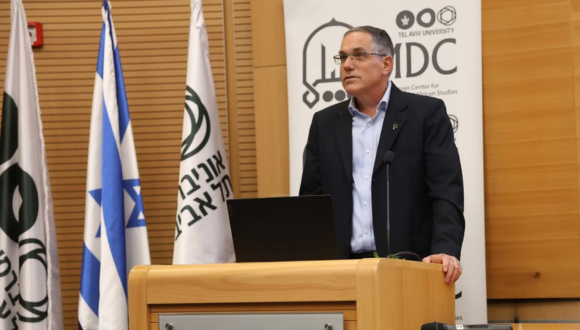
Professor Amos Nadan speaking at one of the conferences organized by the Moshe Dayan Center (Photo credit: Chen Galili)
"We do research for policymakers and we inform the public,” says Prof. Amos Nadan, the head of the Moshe Dayan Center. He notes that this level of engagement has only intensified in recent years.
“People want to hear what we have to say. Foreign ambassadors from Arab countries are visiting in a very open way.”—Prof. Nadan
For students, this means learning in a research setting where academic work is connected to public debate, policy conversations, and the interpretation of major regional developments as they unfold.
The Classroom as a Meeting Point
One of the program’s defining choices is to bring Israeli and international students into the same classroom.
Israeli students may bring Hebrew and Arabic skills, policy or military backgrounds, and firsthand experience of the region’s political tensions. International students arrive with their own academic and professional contexts, from comparative politics and journalism to development, diplomacy, security studies, or regional research.
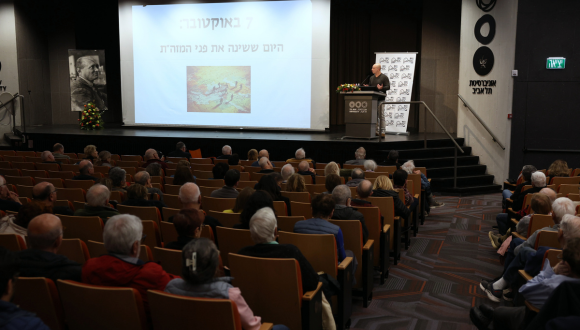
An MDC event dedicated to October 7 (Photo credit: Chen Galili)
That mix matters because the Middle East is often discussed through broad categories: conflict, religion, security, identity. In a shared classroom, those categories become harder to treat as abstractions. Students have to argue more precisely and recognize how the same event can be interpreted through different historical and political vocabularies.
A Schedule Designed for Research, Language Study, and Internships
Classes will be concentrated into two intensive days, Thursday and Friday, leaving the rest of the week open for Arabic or Hebrew language study, library research, Center events, and internships.
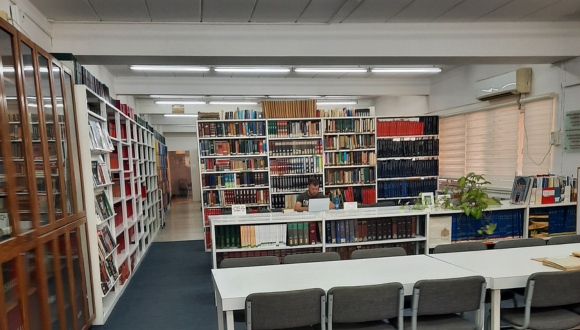
The library at the Moshe Dayan Center offers invaluable research resources (Photo credit: MDC)
“The structured internship will be at the Moshe Dayan Center, so students can work with great scholars.”—Dr. Friedman
Placements are shaped around each student’s academic interests and connect them with active research projects at the Center. “Who the student works with will really depend on what they want to do with their research,” he adds.
Decades of Regional Relationships
What separates the Dayan Center from a typical university department is its institutional memory of engagement with the region.
"In the 1980s, the Center was helping build relationships with Egyptians. In the 90s, it was with Jordanians. During the Oslo process, the Center was involved in facilitating the civil society connection. After the Abraham Accords, we contributed to establishing civil society contacts with the Emirates and Bahrain."—Prof. Nadan
These milestones shape the Center's current work. One active initiative, the Forum for Regional Cooperation, convenes participants from across the Middle East and beyond. Recent discussions have addressed the Abraham Accords, shifting regional alignments, the future of Syria and Gaza, the implications of tensions with Iran for Middle Eastern energy markets, and many other matters.
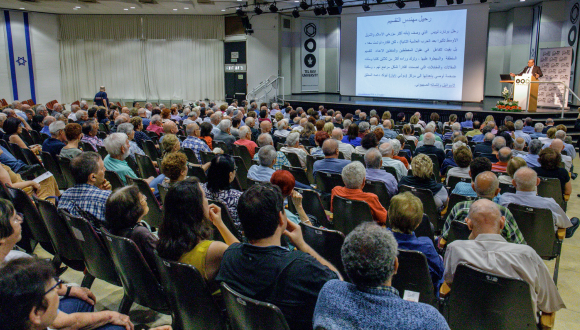
A memorial event dedicated to Prof Bernard Lewis, who donated his rich rare book collection to Tel Aviv University (Photo credit: Gilad Artzi)
Alongside this, the Center is a founding partner of the Konrad Adenauer Program for Jewish-Arab Cooperation, which connects research to life within Israel itself.
An Applied Historical Approach to Middle Eastern Studies
The program trains students to understand how knowledge about the Middle East is produced, challenged, and used by policymakers, analysts, journalists, and researchers.
"The students will be applying academic knowledge to the rapidly changing Middle East and analyzing new situations."—Dr. Friedman.
This orientation reflects the Dayan Center's own working rhythm. Its publications, Tel Aviv Notes, Turkeyscope, Bayan, and others, respond to developments in close to real time. But the program's applied historical approach also asks students to examine how current events are shaped by longer processes.
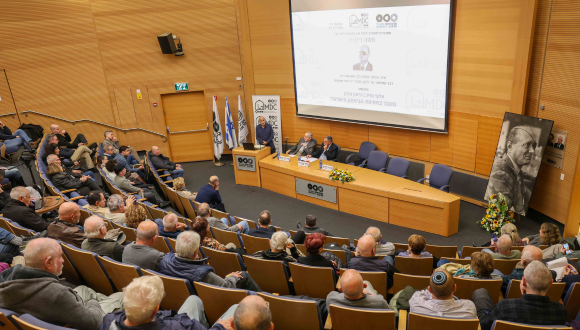
A MDC event (Photo credit: Chen Galili)
The Middle East is often represented through simplified narratives: ancient hatreds, geopolitical blocs, sectarian divides, and so on. The program pushes students past these toward the political institutions, social movements, cultural frameworks, and competing historical memories that actually drive change.
"The program brings together document-based study of the Middle East, along with the bridge building that we do at the Moshe Dayan Center."—Prof. Nadan
Why Study the Middle East from Tel Aviv?
Studying the Middle East at Tel Aviv University means looking from a particular vantage point: inside a country deeply tied to the region’s conflicts, histories, and possible futures.
"The Middle East doesn't slow down for the sake of academic calendars. Studying it effectively means being close enough to feel the pace and having the institutional support to make sense of it."—Dr. Friedman
Apply to the MA in Middle Eastern Studies
Applications for 2026–2027 are now open. Visit the MA in Middle Eastern Studies program for full curriculum details, admission requirements, and upcoming information sessions.
Questions? Contact the MAMES program team
Related Articles