
BA Management Student Gains a Global Business Edge at Michigan Ross
Through Coller School of Management's exchange network, Itzchak Matatyahu added advanced finance coursework, hands-on career training, and a semester inside a competitive U.S. business school.


Itzchak Matatyahu studies BA Management and Liberal Arts at TAU.
He spent a semester at Michigan Ross through Coller’s exchange network.
There, he took finance courses and joined a selective business club.
He gained practical career skills and firsthand U.S. business school experience.
Spring 2027 university-wide outgoing exchange applications open July 1, for students in every faculty.
"Your experience is going to be a direct result of how much effort you put in," says Itzchak Matatyahu, a third-year BA student in Management and Liberal Arts at Tel Aviv University. He treated his semester at the University of Michigan's Ross School of Business as a stepping stone toward eventually working in the United States, and that framing made him deliberate about it.
"That translated into me being very serious about the classes I took. I focused a lot on the actual studies and the extracurricular side of the exchange."
Through the Coller School of Management, BA students can access a wide pool of exchange partners, including Michigan Ross.
Not a Management student? Every TAU student has access to university-wide exchange, with 200+ partner universities in nearly 50 countries. See how TAU Outgoing Exchange works →
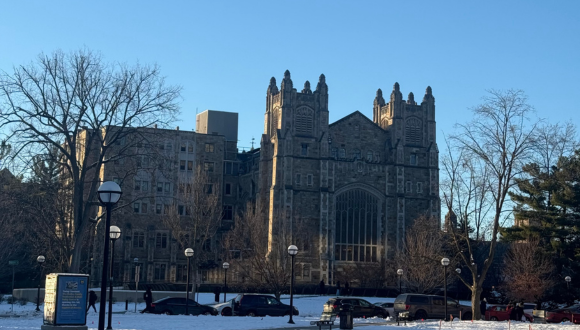
A winter view of the University of Michigan campus, where Itzchak spent his exchange semester.
For Itzchak, who came to TAU from Italy, the semester abroad meant experiencing American business education from the inside: advanced courses, a different campus culture, and a strong emphasis on clubs, networking, and career preparation.
Choosing TAU, Then Looking Outward
Itzchak grew up in Italy and Switzerland and considered several universities before choosing Tel Aviv University. He had offers from well-known institutions in Europe and the UK, but he chose Tel Aviv anyway: “I decided to put the place, the city, and the community first in my priorities.”
The BA in Management and Liberal Arts also let him pair business with another interest.
"I was looking for this kind of broad program where I could study both business and psychology."
Once at TAU, one of the unexpected advantages was the size of the cohort. “We’re a small class. It turned out to be a great thing. You really have the chance to get to know the professors. They get to know you not just as a student, but also as a person.”
That setting, he says, helped him build confidence and take on student roles before he left for Michigan, and it paid off once he got there.
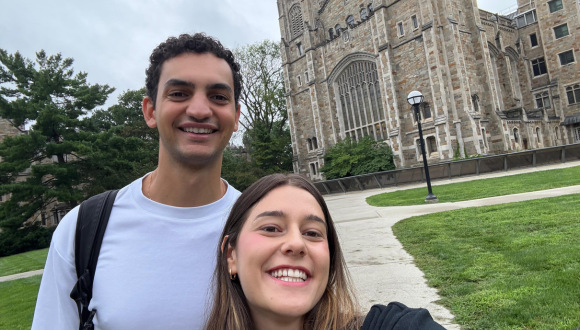
Itzchak Matatyahu with a friend on the University of Michigan campus
He had already been active beyond the classroom at TAU, through TAMID and as a student representative, and his coursework paid off directly during the club's selection process.
"I had already taken principles of finance and accounting by the time I got to Michigan. When I had to do the stock pitch for my interview with the club, I used things I had learned in class. It gave me an edge."
“Being in a small cohort and knowing everybody enabled me to develop my skills,” he adds. “And it made it much easier to integrate well when I went to Michigan.”
Studying Business in a U.S. Classroom
At Michigan, Itzchak chose courses that matched his interest in finance and his longer-term plans: investment banking, private equity, and big data in finance.
Much of the value came from faculty who taught from practice rather than from a textbook.
“Professors are not just teaching you because they learned through text. They’re teaching you from experience. It was amazing.”
His private equity course was taught by a professor who runs a private equity fund. In Big Data in Finance, he worked with SAS and large financial datasets.
A course called the Business of Art took him to a very different field. "We had a budget, made the pitch, went to galleries, and took class trips to Chicago and Detroit. We also learned how to evaluate a piece of art."
A Different Kind of Campus Life
Michigan also gave Itzchak a very different model of university life: “Ann Arbor is a very small city. The whole city is the campus.”
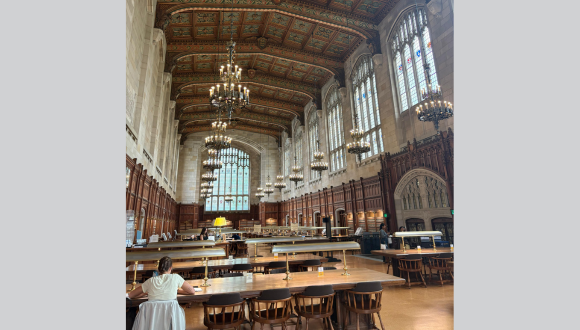
Study spaces at Michigan reflected the academic environment Itzchak experienced at Ross.
That felt very different from Tel Aviv, where students study on campus but usually live and build their social lives across the city.
To Itzchak, Michigan "was really like what you see in the American movies," down to the facilities: "They have three gyms, five basketball courts, all in parquet, and it's all free because you're part of the campus."
The Real Added Value: Clubs, Networks, and Career Skills
For Itzchak, the most important part of the exchange happened outside the classroom. At Michigan he joined TAMID, a highly selective student organization with strong ties to Israel.
"I had to convince them that it was a good thing that I was an exchange student. I wouldn't stay in the club longer, but I would make the most out of it and put in effort that other people wouldn't put in," he says.

Itzchak’s semester abroad included travel and campus life beyond the classroom.
Once accepted, the club became a serious commitment, with meetings several times a week. It introduced him to core career skills: “You have mentors teaching you how to write a CV, how to write a cover letter, how to do an elevator pitch, all the basic things you need for any job interview.”
The investment fund track added weekly elevator pitches and consulting case studies, and to practice networking, new members were expected to set up coffee chats with other members.
"When you do three coffee chats a week for eight weeks, by the last one you know exactly how to do it. It's easy to read about it, but once you do it so consistently, it really becomes part of you."
A Program Structure That Supports Exchange
The BA in Management and Liberal Arts is built with the exchange semester in mind, so it fits into the degree with planning rather than an extra term. Students choose their exchange courses in advance and submit them for credit transfer approval.
Planning starts early. "The program coordinator, Louise Hyatt, does a very good job preparing your schedule. In the second year already, you're talking about whether you're going abroad next year. If the answer is yes, you make your schedule so that when you come back, you're not missing credits."

A house in Ann Arbor, where campus life shaped much of Itzchak’s Michigan experience.
Itzchak’s verdict: "You don't have to do an extra semester. It's very manageable."
Why Exchange Matters for International Students
For international students, studying in Israel already means adapting to a new academic and cultural environment. An exchange semester adds a third country, another business culture, and a wider professional network on top of that.
"For me it was a perfect choice. I want to go to the U.S., and understanding how the U.S. works really makes a difference.”
He noticed a clear difference between European, Israeli, and American approaches to business education.
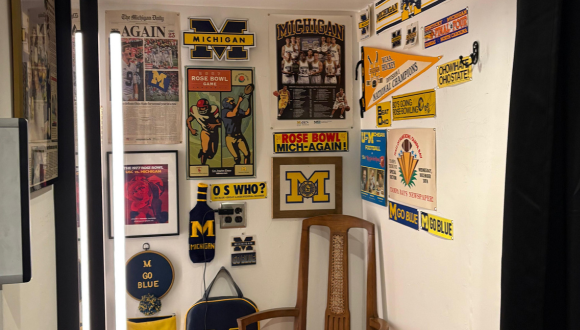
Michigan’s strong campus culture was part of the business-school experience
“Tel Aviv sits in the middle,” he says. “U.S. classes are generally maybe a bit easier, there is so much emphasis on everything outside of the classroom, which is where you actually prepare the most for when you’re going to work.”
His Advice to Future Exchange Students
Itzchak watched classmates miss out by sticking to the exchange-student circle and skipping clubs. "I think they lost so much of what the university actually provided."
"There can be 155 reasons to stay in your own bubble—you don't know anyone, it's difficult, you don't speak the language properly. But going out of your bubble is what makes the experience great."
Preparation matters too. "Don't leave accommodation to the last second, that's a big mistake. Reach out to people who have done it. Be proactive in everything."

Campus and city scenes gave Itzchak a broader view of student life in the U.S.
Travel became part of it as well. Itzchak visited Miami, New York, Chicago, Los Angeles, San Diego, and Las Vegas during the semester. "Some of my best memories from my time in the U.S. were during my travels."
"Give as much as you can and you'll see the results in a great experience."
Learn more about the BA in Management and Liberal Arts at Tel Aviv University and apply online
Not in Management? Spring 2027 university-wide outgoing exchange application is open July 1 to July 31, 2026
Related Articles