‘The Textbook Is Not Being Written’: MBA Students Debate AI at Tel Aviv University
First joint campus event for the Coller Deep Tech MBA and the incoming Sofaer Global MBA cohort at the Coller School of Management.


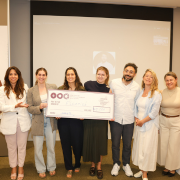
Coller Deep Tech MBA and incoming Sofaer Global MBA students met for the first time at the Coller School of Management for a day of workshops and discussions.
The topic: AI in tech ventures.
Prof. Lior Zalmanson shared his research findings: 30% of people defer to algorithms even when they’re wrong.
VC Eden Shochat challenged the room: “Your next 10 hires are $200-a-month subscriptions.”
Two respected employees are up for one senior role. Alex produces outstanding work with AI but struggles without it. Jordan has deep independent expertise and delivers 25% less output. Who gets the promotion?
This was one of the dilemmas discussed at the From Intelligence to Wisdom in the Age of AI conference, where Deep Tech MBA students met the incoming Sofaer Global MBA cohort.
The conference was organized by the Coller School of Management and featured TAU faculty and guest speakers.
"We are preparing students to lead technology ventures in a world where AI is changing both what companies can do and how people make decisions,"—Prof. Jackie Goren, Head of the Global MBA program, Coller School of Management
"We wanted students to step back from their immediate challenges and examine how they think, what guides their choices, and how they lead others. From my experience in the industry, the hardest decisions often involve incomplete information, competing priorities, and people," explained Dr. Dor Lee-Lo, the Academic Head of the Deep Tech MBA.
The two-year, English-taught Deep Tech MBA has six intensive campus weeks. Between them, students take the core MBA subjects through online classes and independent coursework. The campus weeks are kept for specialized deep tech courses and for lectures and workshops with practitioners.
"Being together creates opportunities that are much harder to reproduce online: candid conversations, spontaneous exchanges, and the trust that develops through working closely with others."—Dr. Dor Lee-Lo, Academic Head of the Deep Tech MBA
When the Algorithm Becomes Your Colleague or Your Boss
Prof. Lior Zalmanson began studying AI at work as a researcher of Uber in New York. "I was taking Uber rides and interviewing drivers. When I asked them who their boss was, they didn't know what to tell me."
The drivers worked 14 to 17 hours a day for a company whose instructions came from a system none of them could see into. Since 2017, Zalmanson and other TAU researchers have studied what they call algorithmic management, and he argues its main target is not the operational floor, but the management.
His lab has been testing how far people defer to AI. The team adapted Solomon Asch's classic conformity experiments, in which participants agreed with a group's obviously wrong answer, and replaced the group with an algorithm.
Across four studies with 1,445 participants, about 30% went along with the algorithm's wrong answer, close to the rate Asch recorded in his experiments.
Some participants said the AI probably knew something they didn't. Others said it simply felt uncomfortable to disagree with it.
When the room turned to the promotion dilemma, one student firmly advocated for Jordan: "AI is based on a corpus of existing knowledge, and for a senior role we need to go beyond the existing knowledge. Senior roles are often driven not so much by human capital as by social capital, the relationships we have with other people, and AI isn't going to help with that at all."
Others backed Alex, arguing that an AI-fluent employee can pass that know-how to the rest of the team. Zalmanson's research suggests this is harder than it sounds.

'Your best AI practice won't scale,' says Prof. Lior Zalmanson
At the Israeli tech company Natural Intelligence, employees built 610 custom GPTs in an organization-wide archive. By August 2025, around 100 were active, mostly used by the people who had built them, and only seven were used by more than one person: "The prompt traveled, the practice did not."
Zalmanson offered no right answer to the dilemma, and said that was the point. "You'd be shocked how many organizations I enter that don't have this internal conversation: What are our values? What aligns best with our current goals? What risk are we willing to take?"
He also introduced shadow learning aspect: when algorithms assign work to whoever is best placed to do it, they also decide who gets to learn. His closing warning applied to the whole field: "The textbook is not being written, and maybe there will never be a textbook."
From Intelligence to Wisdom
Dr. Micah Goodman concluded his session with an explorer metaphor. Christopher Columbus insisted the lands he had reached were India. Amerigo Vespucci recognized them as a continent missing from existing maps. For Goodman, Vespucci is the model of cognitive flexibility a period of rapid change demands.
"We can't prepare for the content of change. We can prepare for change itself. Take a vacation from yourself. Become Vespuccis."—Dr. Micah Goodman
Prof. Nava Levit-Binnun argued that we move between wisdom and foolishness depending on how aware we are of our own biases, and presented attention training and systems thinking as ways to stay on the right side of that line amid information overload. Israel's real startup nation, she suggested, is not its technology but the capacity for inner renewal that existential crises force on people.
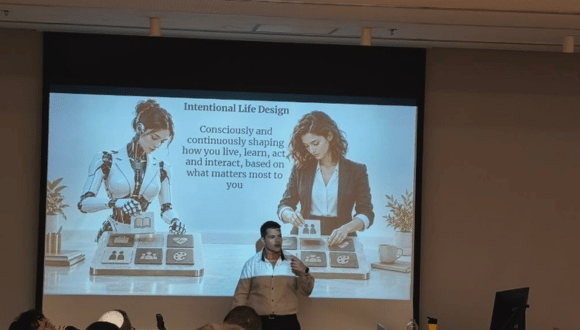
Shay Nulman opened his workshop with a show of hands: who had spent as much time thinking about how to design their life as they had spent designing their CV or a business plan?
"In an age where you can get good at everything, the question I ask is: What do you want to achieve? What do you want your legacy to be?"—Shay Nulman
He told the MBA students that the knowledge, skills and contacts would come, but that "some of the things that lead to real, impactful success — professional, personal, social — are not directly in the curriculum."
What Is Deep Tech Investing?
The program's mentors come from across the industry. They include Tor Ivry, co-founder and CTO of Nanit; Opher Doron, CEO of EVR Motors, whose career spans space, defense and electric motors; and Neil Grunberg, who combines experience as a founder and operator with running an early-stage fund in Toronto. "That breadth matters because deep-tech leadership requires an understanding of technology, markets, finance, and people," Lee-Lo says.
Simon Tobelem, a venture investor and serial entrepreneur who joins the program as a mentor and guest lecturer, sees his first task as defining the term: "A lot of people are talking about technology investment and venture capital without really knowing what investing in technology is."
He separates deep tech from what he calls "private equity tech," in which investors push money into a company to buy market share and disregard the losses. "Deep tech is absolutely not about that. Deep tech is about patient capital, about building an ecosystem, creating connections with universities, with incubators, with industries, with other investors, because deep tech is long cycle," says Tobelem.
"Even in the time of AI, deep tech actually takes years. AI itself took decades before coming to the market."—Simon Tobelem, venture investor and mentor on Deep Tech MBA
Tobelem applies the same view to the current AI boom, using the internet of things as precedent. First comes a fast phase in which "everybody says in a few years everything's going to be connected." Regulation, security problems and failures follow, and only then the second phase of real growth.
"If you don't look at these cycles as investors or engineers, you can miss the right moment to invest, or to start working in it."—Simon Tobelem
Asked why Israel is the place to study the field, he pointed to how close it is: "When you're learning in Tel Aviv, you're going to meet deep tech at every corner, in health, in electronics, in communication, in cybersecurity, in AI."
What Makes an Investor Say Yes?
Eden Shochat, partner at Aleph and founder of face.com, which he sold to Facebook, closed the conference by arguing that the patterns he built over 20 years of meeting hundreds of companies have stopped working. He compared the moment to the early internet, when Yahoo published a weekly page of new sites.
"That same feeling, that something is exponentially growing and we have no idea how it will turn out, is happening now. All our assumptions, all the patterns from 20 years of meeting hundreds of companies, it doesn't work."—Eden Shochat, partner at Aleph and mentor on Deep Tech MBA
He structured the session around four assertions and asked students to vote on the one they disagreed with most. The first was "Your next 10 hires are $200-a-month subscriptions." Experience that once commanded a premium, he argued, now works against founders.
"Second-time founders generally get valuations between 2x and 3x of what first-time founders get. I would posit that that's the liability now. They remember their pattern matching: here are the 20 or 40 people I need to hire."
Some first-time founders only hire two to four people and grow faster. One portfolio CEO spent $2,000 on AI tokens to build a feature himself and generated a $100,000 upsell from each customer. As Shochat put it, "The most expensive thing in building a company is the transfer of context between humans."

Eden Shochat invited Deep Tech MBA and Sofaer Global MBA students to challenge four basic assumptions about the role of AI in tech ventures
Even investor instinct is exposed, he said: "Taste is something that's developed by being trained on the past, your experience, others' experience. But when the world changes this fast, the past is just the wrong thing."
One company Aleph backed with a $20 million seed round replaces instinct with method. It tracks new models and research papers, runs evaluations to test which business problems have become solvable, and then acquires companies whose growth those problems were holding back.
His fourth assertion, "AI is already more creative than most people," drew the sharpest challenge. Shochat cited research in which only 9.4% of human participants scored as more creative than GPT-4 on an established creativity test.
One student asked whether, given everything Shochat had described, this was the worst time to do an MBA or the best. "All of the above are correct," he said.
"Be attentive enough to understand what's going on, because opportunities do present themselves. But they're being closed very fast."
He has placed his own long bet: at 49, he has raised a fund that commits him until he is 61. "Which means that I actually believe there is what to do."
International programs at the Coller School of Management:
Coller Deep Tech MBA: Applications are open for the January 2027 cohort on a rolling basis.
Sofaer Global MBA: Applications for 2027/28 are set to open late November
Management and Liberal Arts BA: Admissions for 2027/28 will open shortly.
Related Articles