Carrying a Middle East Education into the Global AI Race
Tel Aviv University and Columbia University’s Dual Degree BA in Liberal Arts Alumni Spotlight


Asher Dayanim graduated from TAU and Columbia’s Dual Degree Liberal Arts BA in 2024.
At TAU, he studied Middle Eastern Studies alongside entrepreneurship and innovation.
Today, he works in business development at AI-chip company Cerebras, helping governments develop national AI capacity.
His work draws directly on what he learned at TAU about regional politics, economics and technology.
For Asher Dayanim, the subjects he studied at Tel Aviv University have become part of his day-to-day work in the global AI sector. Now in business development at Cerebras, a California-based AI-chip company, he works with governments on national AI capacity, including across the Middle East.
Asher graduated in 2024 from Tel Aviv University and Columbia University’s Dual Degree BA in Liberal Arts, studying Middle Eastern Studies alongside entrepreneurship and innovation at TAU before continuing with economics at Columbia. The combination gave him a perspective he now draws on when navigating technology, trade, regional politics and international partnerships.
In the interview below, Asher looks back on the courses, languages and experiences that shaped him at TAU, and explains how they continue to influence his work, his understanding of the region and the way he thinks about education in the age of AI.
From Middle Eastern Studies to Sovereign AI
The work I do now is closely tied to what I studied at Tel Aviv University and Columbia. At TAU I studied Middle Eastern studies and entrepreneurship and innovation; at Columbia I majored in economics. Today I work in business development at Cerebras, an AI-chip company based in California. I talk with technology ministries and foreign ministries about partnerships, and I work on the sales side for semiconductors.
The job pulls all three fields together. There's a lot of entrepreneurship and business development. There's a lot of economics, because I have to understand trade and export controls. And there's a lot of Middle Eastern studies, because much of the work happens in the region — I've worked with countries across the Middle East, as well as Central Asia, South Asia, and other regions.
What I enjoy most is understanding how different countries are looking to develop, and the different ways they want to use AI to get there.
A lot of my work is helping countries build AI strategies — data centers, a sovereign AI capability, sometimes an indigenous large language model — so they can put AI to work on their own goals.
I also like that the job is about meeting people and providing a service. It's good to be part of that process and to see it from a lot of different angles.
When the Syllabus Becomes the Headlines
I studied in Israel at a very different time, during a relatively quiet stretch. I felt I understood how the country worked, but things have gone to another level since.
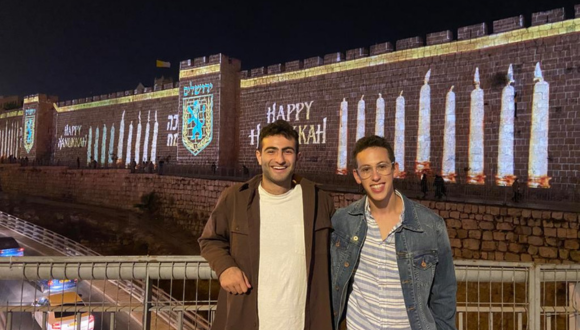
A lot of what we studied is coming into reality. We learned about Iran's nuclearization, the Shia crescent, the divides within the Gulf, and how different countries were beginning to integrate with Israel. Those are now among the most discussed topics in the news every day, and they help me frame the whole picture.
It matters commercially, too. If you want to do business in the Emirates, Qatar, or Saudi Arabia, you have to understand the dynamics of the shifts, the alliances, the competing interests, and how companies fit together.
A great deal of the chip industry runs through the Gulf, so the perspective I built at TAU is something I use directly.
Two Languages That Keep Paying Off
Learning Hebrew was a big part of my time in Israel, and it still helps me meet people and relate to them. In my work now I've gone back to Israel and met with government agencies, including the Israel Innovation Authority — being able to use Hebrew, and what I know about the country, helps the work directly.
In my second year at TAU I also took an introductory Farsi class, taught in Hebrew, on the Hebrew-language side of the university, and I kept it going at Columbia. Later, through my work, I traveled to Tajikistan — a Persian-speaking country, since Tajik is a dialect of Persian — and I used it to speak with the prime Minister and the IT minister. That was an incredible experience.
You Get Out of It What You Put In
One thing I really loved about the TAU program is that you really get what you make out of it. You can walk into class with a notepad and a pencil, take careful notes, ask questions, and learn an enormous amount just by engaging — the professors are always open to meeting you.
But you also learn from the environment. I learned Hebrew. I lived on a kibbutz in the south. I did an internship in Petah Tikva at the Diplomatic Institute, because at the time I was leaning toward the diplomatic route. I traveled around the country and learned as much as I could from the people there.
It's the startup nation, and there's entrepreneurship everywhere, so you pick up different ways of interacting with the world and using technology to solve problems.
For me, a lot of the learning was experiential, alongside the academic side. When I got to Columbia, it was much more library-based and that's important too, but it isn't as experiential.
The Courses That Stuck
A few classes have stayed with me. I loved Introduction to the Modern Middle East with Professor Brandon Friedman. There was so much in it that I thought I understood and didn't, until I worked through the material. I also really enjoyed the Israeli economy with Dr. Paul Rivlin; once you understand how the economy actually works, you can see where the growth is, and how decisions like the shekel stabilization package shaped the country's development. The third was an introductory philosophy course, working through everyone from Plato and Aristotle to Hume, Kant, and Amartya Sen, alongside a course on modernity that ran through Renaissance literature.

Asher (in the middle) with his TAU classmates
For me, wrestling with different theories of how a good person should think and act gives you a moral framework you can actually use. Once you're in a system where money, power, status, and prestige are always present, going back to those roots helps you keep perspective, like leaving Plato's cave and then coming back to it.
TAU courses framed a lot of what I later did at Columbia, whose core curriculum covers similar ground. I'll never forget them.
Education in the Age of AI
I think university education matters now more than ever. I use AI constantly to research, to think things through, to find out who to talk to and how an organization works, so I can walk into a meeting prepared, the way a politician has someone briefing them.
But the best case is for students to realize that the knowledge and the critical-thinking skills you actually hold in your head are what let you have real conversations and work without dependencies. That's where education earns its place: meeting peers and professors who'll be part of your life, and building the knowledge and skills you can then complement with AI instead of using it to skip the steps.
"Developing knowledge you can actually hold in your brain, instead of exporting it into a model, is what lets you interact with AI in a better way."
A Kibbutz, a Crater, and a Country to Explore
I came to Israel at 18, straight out of a COVID year of high school, so my first experience was a two-week quarantine in the dorms. The moment it ended, a group of us who'd become friends went straight to the beach and swam, and it was clear this was going to be a good couple of years.
I spent a stretch on Kibbutz Yotvata in the south, the one that makes the chocolate milk. I worked in grounds and landscaping, and what struck me was the system: people put in their time and create services the whole community can use. If a tree in your yard is overgrown, there's a team of neighbors who come and handle it. Seeing a whole community organize around supporting each other, at that scale, was something.
I traveled a lot, too — a trip to Tzfat with friends, staying in a hostel and meeting all kinds of people; camping in Mitzpe Ramon, setting up a tent and hiking in the crater.
You come away with a real appreciation for how much landscape there is in such a small country.
Looking Back on Studying at TAU
I'm happy with how I did the program, so my main advice would be to trust your gut and really integrate into the broader culture, society, and country. You learn so much more by interacting with locals and joining things you might not otherwise join, going out of your comfort zone. That's why I went to the kibbutz: I wanted a genuinely Israeli experience so I could understand the culture better.
It's easy to stay in a bubble of internationals, and you gain a lot from that too through meeting people from all over the world. Israelis can tell when someone speaks Hebrew, understands the culture, and has spent real time in the country. It signals a connection.
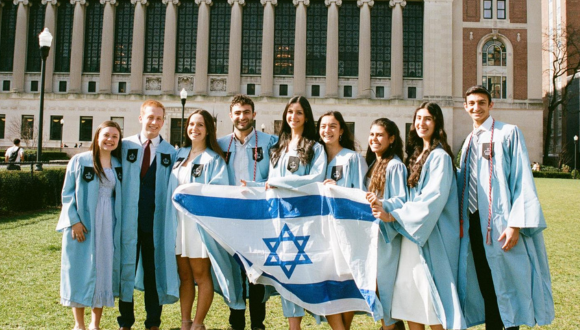
TAU–Columbia Liberl Arts dual BA Class of 2024
The other thing is to appreciate that you have the time to read remarkable books and study with remarkable professors. It's easy to skip the reading and still show up to class.
If you do the reading, work with it, and talk it through with your professors, you get so much more out of the program.
Israel was my first time studying abroad, and the path I took was non-traditional. A lot of people want the standard four-year college program, but you gain so much worldly experience this way that I almost can't quantify how much it's shaped my life. I'd recommend it to anyone considering it.
Message for Fellow Alumni
My message to fellow alumni — and I say it whenever I see them — is to stick together. The experience shaped us, and in the current climate it's important to trust what you actually saw. You saw how the country is and how people treat each other; you know there's potential, that people are kind, and that there's real potential for coexistence. Not many people have seen that for themselves.
It's easy to absorb Israel through TikTok, recordings, podcasts, and the news, and to come away thinking it's a place where everyone hates each other and there's nothing but conflict. The coverage can cast a shadow long enough that you start to forget your own experience. So when you meet someone else from the program, stick together and work to make the world a better place.
Related Articles