What Eight Weeks in a TAU Research Group Looks Like
Three international students — a biomedical engineer, an archaeologist, and a policy researcher — on TAU's 2026 Summer Research Program.


8 weeks in Tel Aviv, working one-on-one with a TAU faculty mentor
Two tracks: Sciences and Humanities & Social Sciences
Independent research internships across TAU's laboratories and research groups, ending in a final symposium where each student presents their own findings
Led by Prof. Ben Maoz (Sciences) and Prof. Milette Shamir, VP International (Humanities & Social Sciences)
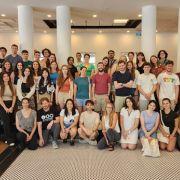
Each summer, the Summer Research Program places international students inside working TAU labs and research groups for eight weeks. The 2026 cohort spread across the program's two tracks: the sciences, led by Professor Ben Maoz, and the humanities and social sciences, led by Professor Milette Shamir.
Three of this year's students describe the same eight weeks from very different rooms: a tissue-engineering lab, an excavation, and a leadership research center.
A Crash Course for New Lawmakers
Camilla Slatopolsky, from New York, spent the summer as a research assistant at the Barak Leadership Center, working in political science and public policy. Her project sits against the backdrop of Israel's coming election, and it starts from a practical question: how do you prepare someone who has never held office for the Knesset?
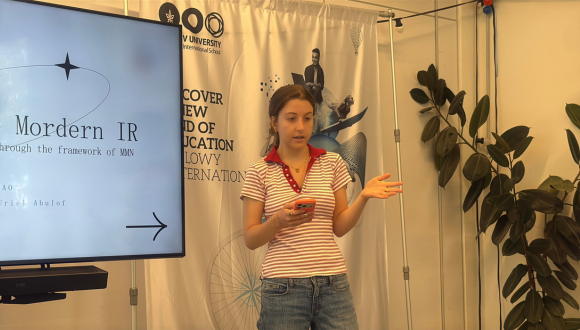
Camilla Slatopolsky presenting her research done during the Summer Research Program in Humanities and Social Sciences
She looked at leadership-training workshops used in other countries to induct newly elected politicians with no prior political background, and at what could be adapted to help new Knesset members move from private life into a very public role.
“The best part about studying here has been the fact that I get to be in Israel, and in Tel Aviv specifically, in such a high-class university with such incredible professors and really leaders of the field, and then have the entire city of Tel Aviv for me to explore.”
“It’s such a welcoming environment and such a great place to be, especially as a young student. As you are building your career, everyone wants to help you more than anything,” she added.
Stem Cell and Organs-on-a-Chip
Ahava Freeman came to Tel Aviv University from the University of Virginia, where she studied biomedical engineering. She used the summer research program as a running start on her master’s in Biomedical Engineering in the lab of Prof. Ben Maoz, who leads the program’s sciences track and whose team organ-on-a-chip systems.
“I didn’t do one specific project, but a lot of training to prepare for the future projects.”
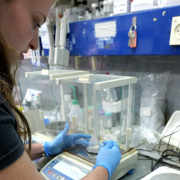
Her main project in the master’s program is going to be Liver-on-a-Chip, which uses human cells grown on an engineered chip to model how the liver functions. “It helps us not have to use mouse models or any other kind of animal models, and also be able to do personalized medicine because we can use cells from actual patients.” She describes the Maoz Lab as a collaborative environment where students share advice and take an interest in one another’s work.
“Everyone eats lunch together and talks to each other about their projects and gets advice from everyone. It’s been such a welcoming environment for me to ask every single question that I have possibly had, which is a lot of them.”
Ahava came to the program with cell-culture experience, but working with stem cells presented a new challenge. “I really thought I knew a lot about handling cells, but I was so shocked. It’s been two months, and I’m definitely still learning about all the specifics about handling stem cells and how sensitive they are. You have to treat them like a newborn baby.”
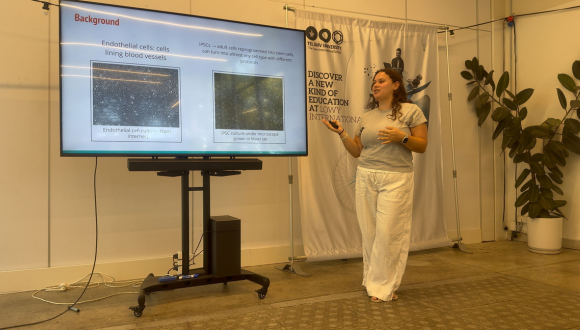
Ahava Freeman at the final symposium of the Summer Research Program in Sciences
From there, her training expanded well beyond cell culture. Over the eight weeks, she ran two major experiments and learned to use flow cytometry, a specialized microscope, and chip-fabrication methods. “I was pretty sure that most of my time was going to be spent working in the sterile hood, with cells. That was mostly right, but I also learned how to work with 3D printers and a lot of other analysis tools.”
Ahava saw how quickly students could progress, even without prior lab experience. One participant arrived with almost no practical experience and, by the end of the program, could work with cells and make the chips.
“As long as you have the motivation, there’s so, so much that you can learn in the short amount of time.”
Archaeology, Biblical Texts, and Tel Hadid
Xu Jingpeng came from China, where he studies biblical texts, to work with Prof. Ido Koch in Tel Aviv University’s Institute of Archaeology. As part of the summer program, he also spent two weeks excavating at Tel Hadid.
“I haven’t studied any archaeology in China, and I’m very much a beginner, but I learned a lot from Ido and his team. I’m very thankful to them. The two-week excavation at Tel Hadid was really educational and really interesting.”
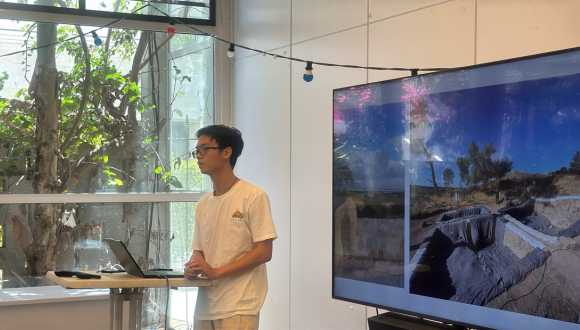
Xu Jingpeng talks about his experience at the Tel Hadid dig
His research examines relationships between the ancient peoples named in the Hebrew Bible. After studying the Philistines, he is now focusing on the Amalekites and looking to archaeology for evidence that can complement his work with texts.
“I think archaeological findings and materials can help explain more about the history of what was going on back then.”
For Xu, this historical research also has contemporary relevance because biblical texts continue to influence attitudes across Judaism, Christianity, and Islam.
“Some religious people will quote phrases or sentences from the Bible to show a specific attitude towards a certain group of people. If we learn more about what it was really like back then, and how the text was formed, we can know more about how people are going to quote it, what the emotional background underneath the quotations is, and also the attitude towards a certain group of people.” What stood out most during his time at TAU was its academic environment.
“The faculty and students are so friendly and so nice. They are very open to talking about their feelings and their thoughts, not only academically, but also about their lifestyles and what is going on here and what is going on there.”
Xu recommends the experience particularly to humanities students interested in the modern State of Israel, the ancient history of the land, or biblical studies.
Interested in the TAU Summer Research Internship?
Watch the Summer Programs page for the Summer 2027 announcement, and choose the track that best fits your interests in Sciences or Humanities & Social Sciences.
Related Articles