
From Classroom to Venture: How the Sofaer Global MBA Turns Ideas into Companies
At the 4th Annual Sofaer Pitch Competition, current students and alumni of Tel Aviv University's Sofaer Global MBA presented ventures shaped by entrepreneurship, mentorship, and Israel's startup ecosystem.


The 2026 Sofaer Pitch Competition at Tel Aviv University featured 14 student and alumni ventures.
Flourish won the Student Track and the $10,000 Arlette Sofaer Prize.
The Alumni Track prize was split between Yaku Pura ($25,000) and GreenBay ($15,000).
The competition showed how TAU’s startup ecosystem connects students, alumni, mentors, and investors.
From sustainable water filtration in Latin America to electric two-wheelers, fleet orchestration, worker productivity, divorce mediation, and recreational-asset delivery, the 2026 Sofaer Pitch Competition brought a wide range of early-stage ventures to the stage at Tel Aviv University.
For the first time, the competition expanded beyond the current MBA cohort to include a dedicated alumni track, bringing graduates back to campus to pitch ventures they have continued building after the program.
Fourteen ventures pitched in all split across two judging panels so each could get a proper hearing. Every team had five minutes to pitch and seven to answer questions, scored on its problem and market, solution, business potential, team, validation, and the pitch itself. Each panel sent two teams through to a final round before the full bench of judges.
- Flourish won the Student Track and the $10,000 Arlette Sofaer Prize.
- In the Alumni Track, the judges split the prize between Yaku Pura ($25,000) and GreenBay ($15,000).
The judges included investors, operators, and entrepreneurs from across Israel's venture ecosystem: Esther Barak Landes of Nielsen Innovate Fund, Sergey Gribov of Flint Capital, Nimrod Cohen of TAU Ventures, Hilly Rejwan Sorek of Viola Group, Gadi Isaev of VentureIsrael, Or Lustig of Matrix Medika, Levy Raiz, and Lisya Bahar Manoah of Arieli Group.
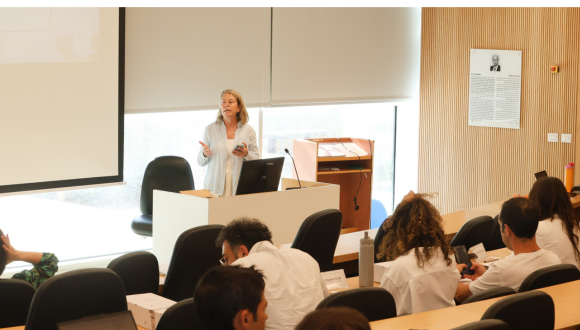
Prof. Jackie Goren at the 2026 Sofaer Pitch Competition at Tel Aviv University (Photo credit: Yael Zur)
Prof. Jackie Goren, who heads the Sofaer Global MBA, has watched the competition grow from a small experiment into a fixture.
"This competition was never really about competition. It's about creating a space for people to dare, to think, to create something new, and to feel comfortable enough to share it."
The judges didn't treat the pitches as polished presentations alone; they used the Q&A to test each venture's assumptions — where users would come from, whether the market was large enough, how teams would price, hold quality as they grew, and make the economics work. For some, they pushed for sharper competitive positioning; for others, they questioned whether the market justified the effort and investment required.
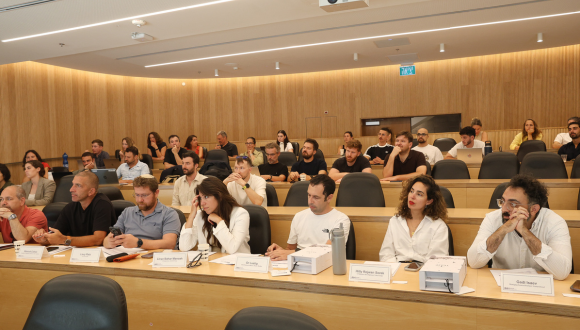
Nimrod Cohen (front row, second from the left) on the jury of the 4th Sofaer Pitch Competition (Photo credit: Yael Zur)
Nimrod Cohen — Managing Partner of TAU Ventures, the university's venture arm and Israel's first university-based VC fund — was struck by how teams held up under it.
"People defended their ideas well, which says a lot about how prepared they came in." — Nimrod Cohen, Managing Partner of TAU Ventures
Why Open the Competition to Alumni?
This year's competition formed part of the Sofaer Global MBA's 15th anniversary, and the alumni track was how the program marked it. It began, in Goren's words, as "a brave experiment": the team wasn't sure graduates scattered across Israel and abroad would fly back to pitch — and then the applications came in.
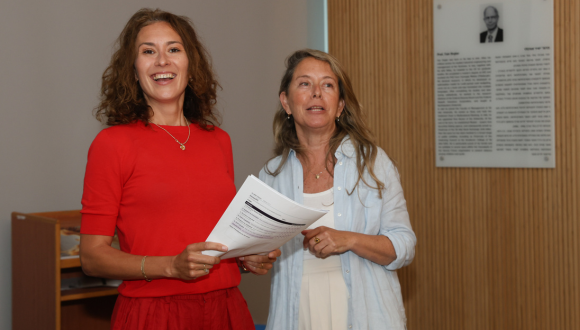
Prof. Goren (right) with Sofaer Global MBA alumna Shaina Leykin. (Photo credit: Yael Zur)
On the day, the audience spanned the program's history, with alumni from across its fifteen years, two from the founding 2010 class. The track was made possible by an anonymous gift to bring graduates back into the program's orbit. It was organized by Shaina Leykin, a 2025 graduate, and Goren expects it to anchor the alumni community going forward: "I think it will be the beginning of a tradition."
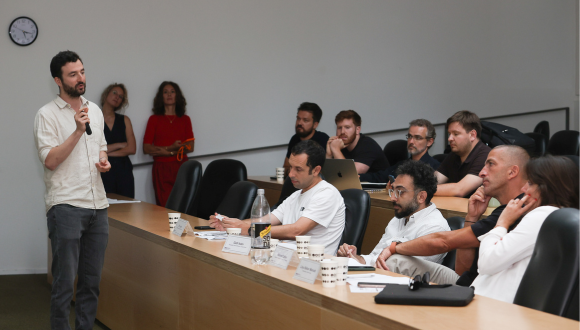
The alumni track of the Sofaer Pitch Competition (Photo credit: Yael Zur)
How Is AI Reshaping the Ventures MBA Students Pitch?
For Goren, the shift this year was visible in the ideas themselves. "There were more tangible ideas, and everyone talked about the combination between humans and technology. The human side was very present."
In an AI-driven world, Goren argues, business education is less about transferring knowledge than about training the capabilities that stay human: judgment, creativity, collaboration, resilience, communication, and the ability to build something meaningful with other people. She calls the MBA a gym for human capabilities — a place to strengthen the skills that will matter most:
"In the AI era we're facing, being able to train our brain muscles, our speech muscles, our cognitive abilities — that's a blessing."—Prof. Jackie Goren
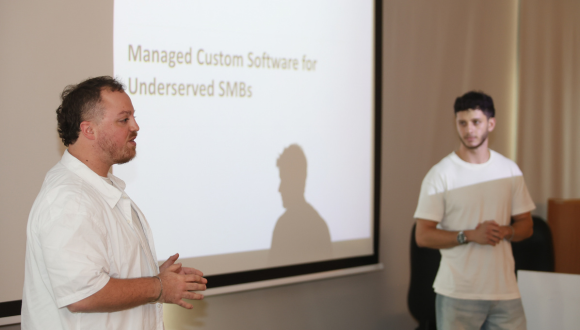
One of student teams presenting their venture at the 4th Sofaer Pitch Competition (Photo credit: Yael Zur)
Cohen saw the same from the judges' side: the level "keeps climbing year over year," with AI part of it.
"Teams move faster and show more polished work earlier. It's not just the tools — the bar the founders are setting for themselves is just higher now."—Nimrod Cohen
Goren is careful not to treat technology as the only marker of a serious venture. "The advantage of a business school is that we can also give a stage to brick-and-mortar ventures — ones that grow not necessarily from technology, but from a deep understanding of the market," she said. But she's clear about where the conversation keeps heading:
"Today people like to talk about deep tech, and also big markets that scale and grow."—Prof. Jackie Goren
The frontier where AI and deep technical capability are the venture itself is the focus of the Coller Deep Tech MBA, the deep-tech program within Coller's Global MBA, alongside the Sofaer Global MBA.
The Student Ventures: Straight from the Classroom
Flourish, the student track winner, is a women's health venture built around natural support for the menstrual cycle. Its four founders — Liora Kubala, Melina Lopatin, Juliette Bergwerk, and Ana Paula Albin — come from biotech, finance, and marketing, and didn't begin with women's health at all. "We started with a completely different idea," recalled Lopatin, who delivered the pitch.
"After a few weeks, we sat down and asked what really motivates us, what we actually care about — and the cycle came up. We asked: why isn't there a solution for this? So we decided to build one."—Melina Lopatin
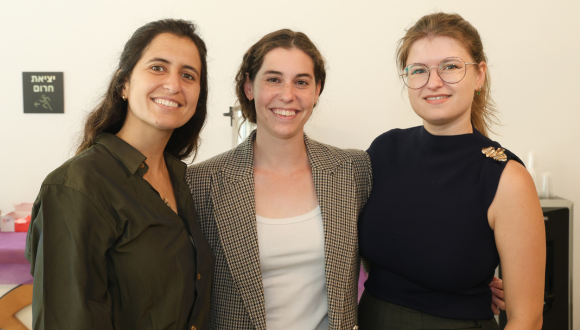
Members of the Flourish team (left to right): Ana Paula Albin, Melina Lopatin, and Liora Kubala. (Photo credit: Yael Zur)
For Kubala, the motivation was personal. "In my family we have someone suffering from endometriosis, and it's horrible — you hear those stories over and over again," she said. The team started with natural cycle support, building out toward conditions like endometriosis and PCOS.
Albin credited the New Venture Creation course and their mentor, Ido Maslaton, with sharpening the idea.
"Our mentor supported us from the beginning and kept challenging us to see the gaps we could fill." — Ana Paula Albin
"Once we had the idea, we fell in love with it," Albin added. "It's something we identify with as women, and something we want to keep building."
"We're fully committed to making this happen. It's one of our first pitches, but not our last." — Melina Lopatin
Brooklyn Electric, the second student finalist, is working on electric two-wheelers — revamped, electrified bikes and motorcycles. Its founder made Aliyah in 2018 and is moving the project from prototype toward market.
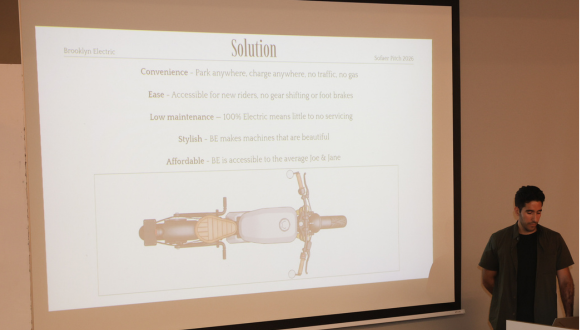
Brooklyn Electric presentation (Photo credit: Yael Zur)
Other student ventures ranged from AI-driven software to hands-on services: a behavioral-health platform pairing wearable biometrics with AI to give clinicians real-time insight between therapy sessions; an AI tool that hands middle managers consultant-grade, cited analysis on demand; modular digital systems to help small businesses run faster and leaner; a white-glove delivery service for boats and RVs, inspired by a founder's own boat parked far from home in Miami Beach; and a carpool-based service for retrieving forgotten items.
What the Alumni Built
The alumni field showed what a few years past graduation can do for an idea, and the panel chose to recognize both finalists. For current students, the track was a preview of life after graduation: these ventures were further along, several already piloting, generating traction, raising funding, or operating across markets. With graduates now spread across the globe, several teams pitched online rather than in person, Yaku Pura among them.
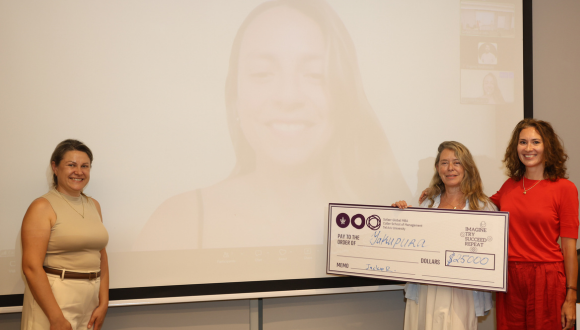
Carolina Placencia joined online to pitch Yaku Pura (Photo credit: Yael Zur)
Yaku Pura, which took the larger of the two alumni prizes, scales sustainable, point-of-use water filtration across Latin America, where unsafe tap water is a daily reality. Founded in 2018, it is active in three countries, has closed a pre-seed round, and reports — by its own account — 30% year-on-year revenue growth and around 20,000 families served across retail and digital channels.
"Every dollar builds access to clean water for families around the world. We're asking you to be part of our story." — Carolina Placencia, Yaku Pura founder (2023 cohort)
GreenBay, presented by Daniel Odesser (Class of 2019), is a fleet-orchestration platform for the EV transition: it connects the separate software tools a fleet runs on and uses real-time data and AI to allocate resources, diagnose problems, and recommend fixes. The team has raised a pre-seed round and is starting pilots in London, charging for the value created rather than the software itself.
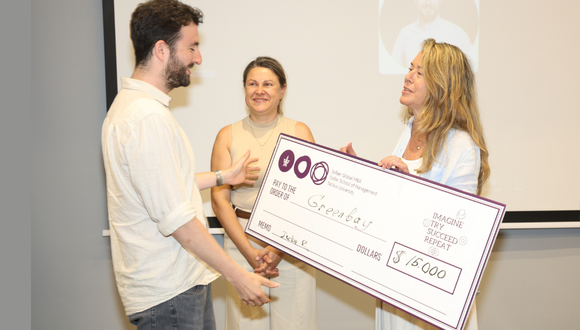
Daniel Odesser of Greenbay receives the Sofaer Pitch Competition prize from Prof. Jackie Goren (Photo credit: Yael Zur)
Beyond the finalists, the alumni lineup was every bit as diverse: tackling labor shortages in US light industry by showing each worker what they can earn and giving supervisors a team-wide view; turning offline restaurant marketing into measurable revenue through QR-based promotions; a platform for uncontested divorces in Florida with Spanish-language access already in pilot; immersion-cooling enclosures for the heat from high-end and AI computing; and an AI-powered presentation tool.
How Does a Classroom Idea Become a Venture?
Goren described a pipeline built into the Sofaer Global MBA curriculum: it begins with ideation, moves into building a working MVP — often with computer science and design students — then runs through the New Venture Creation course, where teams pressure-test their financial models, marketing, and whether a market exists at all. Pitch coaching comes last; the competitions are where it gets tested in public.
"We give a lot of support. Some students come with ideas, some have no clue at all. The point is to help them turn it into something that actually works — not just a problem and a solution, but a venture."—Prof. Jackie Goren
What founders underestimate, Goren said, is the work, taking in a lot of advice while deciding what to keep, and, above all, the team. "Working in teams is not easy. Your teammates for the whole venture are more than getting married. You really need to know how to work with them."
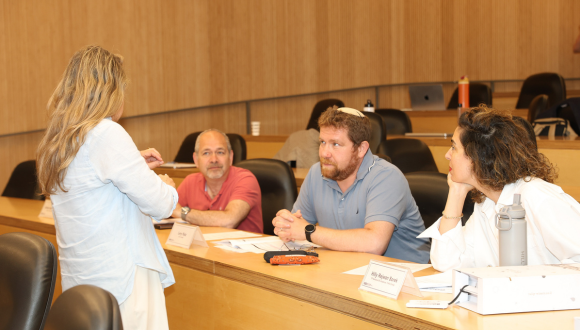
Prof. Jackie Goren and Sofaer Pitch Competition judges (Photo credit: Yael Zur)
Founders, Cohen said, tend to over-polish the idea itself — "the feature, the tech, the 'wow' moment" — when "investors care less about how clever the idea sounds and more about whether the team actually understands their customer and can execute under pressure. The pitch should be built around the problem and the team's ability to solve it, not the product." The line between a class project and a company, he added, was simple:
"A classroom project usually stops at 'this could work.' A real venture starts with 'this already works, even a little' — some sign of traction, a real user, a problem someone outside the room actually feels. The difference isn't ambition; it's evidence."—Nimrod Cohen
Build Your Own Venture at TAU
For the Sofaer Global MBA, the Pitch Competition is a concentrated expression of what the program sets out to do: help the international students who come to Tel Aviv University turn their ideas into companies, in an environment where mentors, investors, and faculty push them to make it real.
At Tel Aviv University's Coller School of Management, the Global MBA brings together two complementary programs, both taught entirely in English:
- Sofaer Global MBA, focuses on entrepreneurship, innovation, and venture creation,
- Coller Deep Tech MBA is designed for experienced technology professionals aiming to lead deep-tech ventures.
Both programs share a philosophy of preparing people not simply to adapt to change, but to create it, and both are rooted in Tel Aviv's innovation ecosystem, pairing rigorous coursework with hands-on building, global perspectives, and direct access to founders, investors, and industry leaders.
Applications for Sofaer Global MBA and Coller Deep Tech MBA are open for 2026–2027
Frequently Asked Questions about the Sofaer Pitch Competition
What is the Sofaer Pitch Competition?
The Sofaer Pitch Competition is an annual startup-pitch event at Tel Aviv University, run by the Sofaer Global MBA at the Coller School of Management. Now in its fourth edition, it brings current students and alumni together to pitch early-stage ventures to a panel of investors and entrepreneurs from Israel's startup ecosystem. The 2026 competition featured 14 ventures.
Who won the 2026 Sofaer Pitch Competition?
Flourish, a women's health venture, won the Student Track and the $10,000 Arlette Sofaer Prize. The Alumni Track prize was split between Yaku Pura, which scales point-of-use water filtration across Latin America ($25,000), and GreenBay, an EV fleet-orchestration platform ($15,000). All three teams were founded by Sofaer Global MBA students or graduates.
What was new at the 2026 Sofaer Pitch Competition?
For the first time, the competition added a dedicated alumni track, marking the Sofaer Global MBA's 15th anniversary. Graduates returned to Tel Aviv to pitch ventures they had kept building after the program — several already piloting, earning revenue, or raising funding — alongside the current student cohort.
What kinds of startups do the Sofaer Global MBA competitors build?
Ventures span software and hands-on industries alike, from women's health and electric two-wheelers to water filtration, EV fleet software, and behavioral-health tools that pair wearables with AI. Founders focused on deep technical innovation can also pursue the Coller Deep Tech MBA, which runs alongside the Sofaer Global MBA at Tel Aviv University.
TAU is ranked #7 globally and #1 in Israel for producing VC-backed entrepreneurs (PitchBook, 2025).
Related Articles