From China to Tel Aviv: Studying Political Science in Israel at Tel Aviv University
Jianlian’s interest in Israel started with stories, documentaries, and military history. Today, it has become the focus of her academic life in Israel.


Jianlian’s interest in Israel grew from teenage curiosity into advanced academic research at TAU.
After studying Hebrew in China, she came to Tel Aviv University for the MA in Security and Diplomacy.
TAU’s international classroom, flexible academic culture, and faculty support helped her move toward doctoral study.
She is now pursuing a PhD in Political Science, continuing her research in Israel.
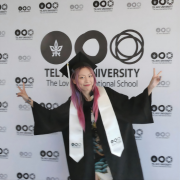
Jianlian earned her undergraduate degree in Hebrew Language Studies at Beijing International Studies University and spent a year abroad at the University of Haifa. Today, after completing an MA in Security and Diplomacy, she is pursuing a PhD in Political Science at Tel Aviv University.
As a teenager, Jianlian became fascinated by Israel’s military history and the stories surrounding the country: “There was always this incredibly capable spy character, and somehow, they always turned out to be Israeli.”
During the year she took China’s college entrance exam, Beijing International Studies University opened its Hebrew program for the first time, a program that only admits students once every four years. Jianlian applied immediately.
“My parents knew I was genuinely interested in Hebrew. And because it is such a niche language, they also felt it would offer unique career opportunities.”
Although she studied languages as an undergraduate, Jianlian never saw herself becoming an interpreter. “Translation is about communicating someone else’s ideas,” she explained. “I’ve always been more drawn to work that involves curiosity and creativity.”
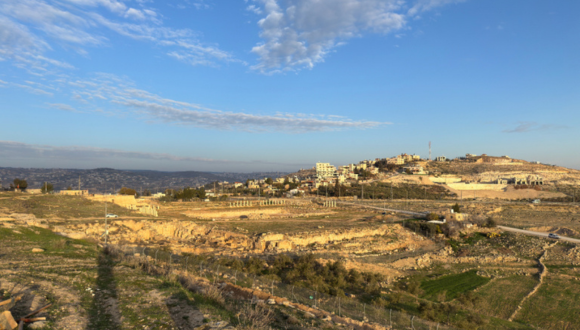
A view of one of the achaeological sites Jianlian visited in Israel
During her first summer break, she visited Israel for the first time with her family. Later, in her third year, her entire class spent a year abroad at the University of Haifa.
“Even after studying Hebrew for years, seeing the Mediterranean in real life felt completely different from reading about it in textbooks.”
Choosing TAU
After graduation, Jianlian’s classmates took very different paths. Some continued in academia, others entered Hebrew-related professions in China, and some moved into unrelated industries. Jianlian chose to return to Israel for graduate school.
She applied independently to the English-language MA program in Security and Diplomacy at Tel Aviv University, without using an application agency.
“The application process was actually very straightforward. Everything was clearly explained on the university website.”
She chose TAU for its faculty and research strengths, and for the city itself:
“The city is open, diverse, and very welcoming to international students. Academically and socially, it felt like a place where I could really grow.”
The program pleasantly surprised her: “Some professors are incredibly accomplished, but very humble. You only realize how impressive they are after looking at their research backgrounds.”

Jianlian shows one of the finds at an archaeological excavation in Israel.
Her classmates came from more than 20 countries, creating a highly international classroom environment. Although she began the program with little formal background in international relations, the foundational curriculum helped students from different academic disciplines adapt.
One aspect of Israeli education stood out to her in particular: its flexibility. “You can retake exams. Sometimes there are multiple ways to complete assignments. There’s less pressure to succeed perfectly on the first try.”
It was not always easy. When her advisor encouraged her to develop one chapter of her thesis into a publishable academic paper, navigating research methods and the publication process for the first time was, at moments, frustrating, but also formative.
“Israeli education gives students a lot of freedom, but also a lot of responsibility. You’re expected to grow through the process.”
Continuing into a PhD
By the time she finished her MA, Jianlian knew she wanted to stay in academia. She was admitted into the Political Science PhD program at Tel Aviv University with full funding—a scholarship that covers tuition along with a monthly stipend.
Studying in Israel already made it easier to build relationships with faculty and prepare her doctoral application.
Political science training in Israel places a strong emphasis on theory and research methods. The first year combines intensive coursework with methodological training, followed by qualifying exams. Most students complete the program in four to five years.
"Even the qualifying exams come with a retake option," jokes Jianlian.
Looking Back
When asked about her most memorable experience in Israel, Jianlian did not mention research or conferences. Instead, she talked about visiting a local middle school.
A classmate from the East Asian Studies department invited her to introduce Chinese culture to Israeli students, and she shared stories about the Tujia ethnic culture from her hometown.
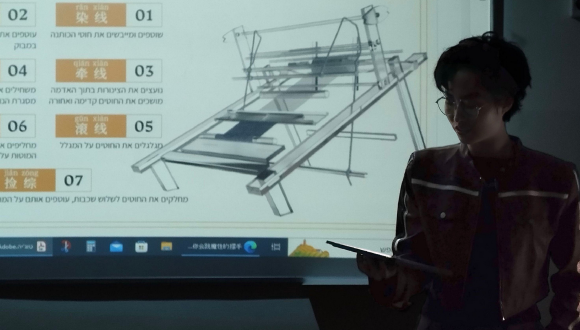
Sharing Tujia culture with Israeli school students.
“The students were energetic, expressive, and incredibly curious. The whole atmosphere felt relaxed and lively.”
She also admitted that before moving to Israel, she had romanticized the country to some extent: “Maybe I imagined it a little too ideally at first.”
Over time, she came to appreciate Israel in a more grounded and realistic way. And if she had the chance to choose again? Her answer came immediately: “Absolutely.”
“At first, I was mainly attracted by the stories and history. But over time, I realized that to truly understand Israel, you also have to understand its religion, culture, and society.”
Tel Aviv University International Programs
Jianlian's path began with Hebrew and led her through a master's in Diplomacy and Security Studies to a PhD in Political Science. If her story resonates, these programs may be a good place to start:
- MA in Security and Diplomacy — Jianlian's master's program
- MA in Middle Eastern Studies — for students interested in the region's politics, history, and society
- Hebrew Ulpan — intensive Hebrew language programs at every level
Applications for the 2026–2027 academic year are open on a rolling basis.
Other related programs at TAU’s Lowy International School:
Related Articles