A Lesson in "Pure Cinema" with Sergei Loznitsa
A prominent filmmaker brought his craft, his business advice, and his unreleased masterpiece to a workshop for Tel Aviv University film students


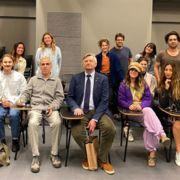
Filmmaker Sergei Loznitsa taught MFA Documentary Cinema students at Tel Aviv University for four days.
He showed parts of his latest film he's working on.
He revealed that every sound in the archival film was built from scratch.
He critiqued students' own films, pushing them to rethink where the camera sits and who holds it.
He also covered the business side: producer contracts and his rules on pacing and length.
During a four-day workshop, Loznitsa screened parts of the latest feature he is working on, then explained how he built every sound in the film from scratch.
MFA Documentary Cinema student Maarika Freund recounts four days of feedback, blunt business advice, and a redefinition of what a documentary can be:
In the first week of June, the MFA Documentary Cinema Class of 2027 had the joy of learning from Sergei Loznitsa, who came to Tel Aviv University to give a masterclass.
Born in Ukraine, Sergei is most famous for his use of Soviet archival footage, like State Funeral, which contains never-before-seen footage of Joseph Stalin's funeral from March 1953, and for his signature documentary style: observational, without voiceover, text, or dialogue, which he calls "pure cinema," where only the image explains what is happening. His last film, The Invasion, made in that style, premiered at Cannes in 2024 as his personal response to his people's invasion of Russia.
As someone who understands the realities of war and how life goes on despite it, Sergei felt right at home in Tel Aviv, telling me after our first session that he's been to the city many times and knows it quite well. This semester has been disrupted by the Second Iran War, so we were especially touched that someone of his caliber was so eager to come and be with us.
A Film Built from Scratch
We spent four well-rounded days with Sergei, including a private screening of his newest film dedicated to never-before-seen footage from the Soviet Union.
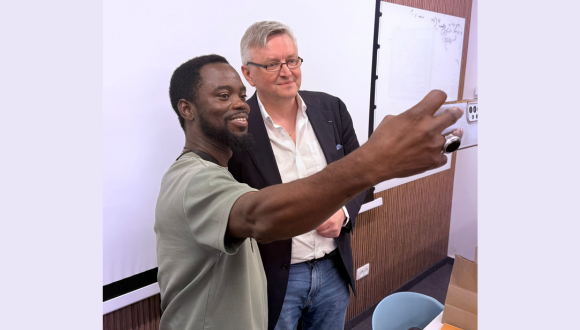
Freund's classmate David Asare Masterwille, from Ghana, with Sergei Loznitsa
When we were watching the film, we also received intimate, inside information about its creation, specifically that all of the sound in the film was made from scratch.
He spoke at length about the intense sound design he built to accompany the silent, archival material, which he carefully arranged in a series of scenes that showcase the diversity and disparity across all of Russia.
So while the archival footage is true to the documentary form, there is a huge element of play within the, sometimes absurdist, soundscape that accompanies each image on-screen. Because of this, he didn’t call this last piece a documentary, but rather “a creation”, especially because presenting the Soviet Union in such a way could be seen as a mockery, a comedy about the Soviet Union, perhaps.
“It of course can be dangerous because we might touch on a question that nobody wants answered. It’s an illusion, of course, but if it works, great! That’s cinema.”
"Who Is Filming This?"
Sergei also gave us feedback on our own work. I partnered with a fellow classmate, Kennedy Farrow, and we chose to document an intimate moment: the application of scar tape on my cesarean scar. I am quite interested in telling women’s stories and am thoroughly enjoying the exploration of the multitude of ways one can make documentary cinema today.
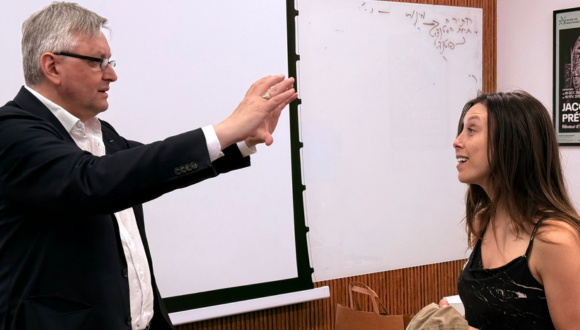
MFA student Kennedy Farrow (right) with the filmmaker Sergei Loznitsa
Sergei pointed out something very interesting about our two-minute film. He felt like the documentation of this instance was actually fiction! We were all shocked. This was a real moment, captured in real time. I really did need to apply the tape, and it’s something I do regularly. How could our two-minute film have been considered a fiction? He responded:
“It’s an intimate moment. It’s not an action you would have someone regularly witnessing. So it makes me ask: who is filming this? And when I ask myself that, I feel like we are in the world of fiction.”
We all wanted to know how this feeling of being in a fiction film could have been avoided. His answer was very thoughtful and insightful: Kennedy and I could have had a dialogue while I was applying the tape, as her open presence would have implied an invitation to witness the intimate moment. Alternatively, I could have set the camera up myself.
In essence, he was teaching us the importance of making the camera invisible within documentary filmmaking so that what is happening in front of our eyes doesn’t feel like a staged illusion.
I loved the feedback and am still very proud of the work Kennedy and I presented. She created a really gorgeous panning shot and we worked really hard together to create a dynamic soundscape that was inspired by Sergei’s work. However, his feedback did make me reflect more on the placement of the camera, and all of the different ways that we could tell the same story. This is why I left the workshop feeling so inspired!
My mind was opened and my scope of what’s possible has been forever changed in a really positive way.
The Business of Documentary
What I also appreciated was that Sergei spent an entire session with us talking about the business side of the industry: what kind of contracts to sign and what to avoid when working with a producer for the first time.
He also gave us very important tips on how to create and shape our documentaries:
- A filmmaker has up to ten minutes before an audience needs a narrative,
- The perfect film length is 80 minutes,
- After forty-five minutes you must show your audience something beautiful.
Written by: Maarika Freund (née Pinkney), MFA Documentary Cinema, the class of 2027
Ready to join Class 2028? Applications for Fall 2026 intake of the Documentary Cinema MFA are now open.
Related Articles