Why Tel Aviv University’s "DNA" Is Israel’s Most Vital Social Export
Democracy Now, Anew


In his famous quote, Spider-Man’s creator, Stan Lee, wrote, “With great power comes great responsibility.” One professor of political science thinks this makes Spider-Man the villain of modern politics. After all, he says, we know it’s empirically false: power holders shirk responsibility. Worse: if true, what would that mean – “with little power comes little responsibility”?
That’s the conclusion many of us unwittingly draw, says Prof. Uriel Abulof from Tel Aviv University’s School of Political Science. The Spider-Man Fallacy, he argues,numbs us, the citizens.
If the meaning of the word ‘Democracy’ in Greek is dēmos (“people”) and kratos (“power”), how is it that the people in supposedly democratic countries feel so powerless and have little to no say in the critical decisions that influence their own lives?
In a recent poll, when Prof. Abulof asked Israeli citizens what the essential attributes of a democracy are, the majority 126 out of 204) said they are a combination of two elements: ‘Separation of Powers’ and ‘Consent of the Governed’.
In another question,he asked respondents to complete the sentence “there’s no democracy without…”.Here,half voted that democracy is predicated on ‘Civil Rights (liberalism)’ and/or ‘Social and Economic Justice’.
Prof. Abulof says that if he voted, he’d be part of the tiny minority who believe that both answers to both questions are, in fact, WRONG. “Our capacity to both know that democracy is ‘government by the people,’ and say that it’s about ‘the consent of the governed’ is the most insidious mental gymnastics of our time, straight out of Orwell’s Doublethink: the ability to hold two contradictory beliefs simultaneously and accept both as true.” Equating democracy with liberalism is another common mistake, he argues: “there’s no crisis of liberal democracy; there’s a crisis of liberalism because there’s no democracy.”
Israel is no democracy, says Abulof, but is no exception either: “No country in the world, except perhaps Switzerland, has ever had a real democracy since its inception in Athens, more than 2,000 years ago.” Like the Founding Fathers of the United States, we’ve chosen Rome over Athens, and that’s exactly what we got: an oligarchic republic, whether liberal or not, that we call “representative democracy,” which is neither democracy nor represents anyone but the very few. Opting for Rome, according to Abulof, we shouldn’t be too surprised that we’ve turned politics into a gladiator arena, and “we, the people” into mere spectators.
Beyond the Battleground
Israel is facing a historic moment of reckoning, in which the existing political structure can no longer provide effective, legitimate answers to the core issues dividing society, nor genuinely reflect the sovereignty of the people.
Israel’s representative system, like that of many countries, is based solely on periodic elections for politicians and parties, depriving citizens of any direct influence over policymaking. It does not encourage accountability of elected officials outside election seasons and struggles to produce public decisions with broad legitimacy. Israeli politics, it seems, has become a battleground of personal and identity-based conflicts, rather than a space for meaningful public dialogue. Public trust in institutions has been eroded to the core – and democracy itself feels hollow.
If this is all true, what can be done?
The DNA of Democracy
By launching Democracy Now, Anew (DNA), Prof. Uriel Abulof, from Tel Aviv University, is trying to mend the most fragile system of all: the public square.
If democracy is the key to a stable society, the world’s current political "lock" appears stuck. The DNA project (initiated by Prof. Abulof and BA student Rony Kadosh, supported by two of her classmates Reut Adinayev and Nitzan Fialkov) offers the master key: a new political operating system built on democracy’s foundation: deliberative participation and direct self-determination.
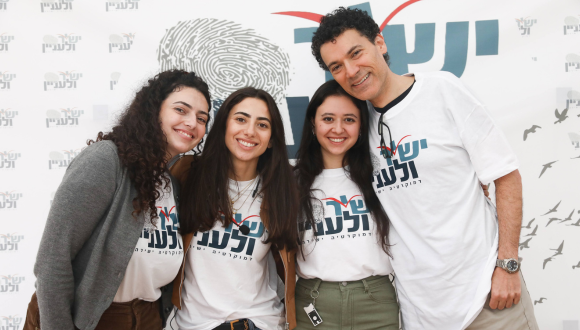
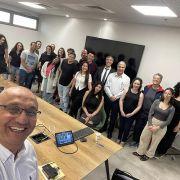
Prof. Abulof (right) with TAU students Rony Kadosh, Reut Adinayev, and Nitzan Fialkov
By intertwining informed, deep-level conversation with the power of the direct vote, via referendums, this model moves beyond the shallow polling of the past.
Prof Abulof’s vision sounds counterintuitive: “I want people to feel comfortable forgetting who the prime minister is,” he said, “not because of amnesia or ignorance, but simply because who the PM is would matter far less than what (not whom) ‘we, the people’ want. Determining our own destiny, we’ll help politicians become what they should have been all along: public servants.”
Proof of Concept
While DNA is a nationwide initiative, outlining a detailed plan for institutionalizing citizens’ assemblies and referendums (“Hakhel”), Prof. Uriel Abulof started the initiative in TAU, which has become the hub of its pilot: the first ever implementation of its principle and practices, in three phases.
First, in a preliminary poll, the campus was invited to choose a topic for deliberation and self-determination; a plurality chose the university’s response to a constitutional crisis. Second, a students’ assembly was then formed, partly through sortition (people are chosen by chance to serve, much like jury duty).
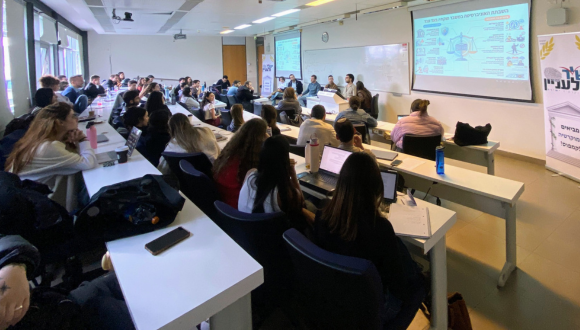
TAU students assembly in session
In an intense week-long discussion, its 44 members gradually formulated an elaborate blueprint for the university's response to the possibility and reality of a constitutional crisis. Finally, the referendum: the whole campus – faculty, staff, and students alike – was invited to cast their vote for or against the Assembly’s proposal. Here's a summary of the proposal:
-
In Routine Times: promoting democratic discourse, make knowledge accessible, and bridge the gap between the university and the general public.
-
In Emergencies: Activating a gradual response mechanism to a constitutional crisis.
-
Strike Protocol: Approval (with a quorum of 1,000) will lead to a 48–hour warning strike of the entire university.
Successful DNA testing?
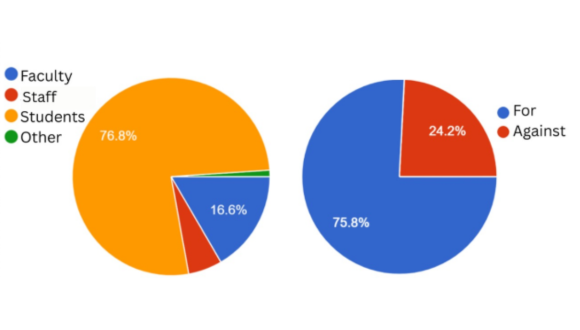
During TAU Democracy Week in December 2025, the entire campus was invited to decide in this first-ever all-university referendum. More than three–quarters of all voters, about the same ratio in all three main groups, supported the proposal.
The team concludes this “DNA testing” with great satisfaction. “Nothing like that was ever tried, let alone accomplished, so there’s no ‘institutional memory’ to draw on,” Prof Abulof says, “now add to the mix Israelis’ growing fatigue and cynicism, and you get how hard it’s been – and how rewarding.”
While the preliminary poll and more so the concluding referendum went very well, the Assembly in-between proved most uplifting, Abulof said, “whether Jewish or Arab, religious or secular, right or left – they truly saw each other, listened, and created something new and important for the entire campus, and I dare say for Israeli society.” It’s not easy to encourage people to participate, but close to 2000 university citizens did.
Where is this taking us?
Prof. Abulof says this small-scale experiential experiment is only the beginning. “We carried out the first-ever academic pilot of revived 3D democracy – not only delegative, but deliberative and direct.
“We’re inverting Spiderman: with great responsibility comes great power. By shouldering the responsibility for our fate, we embrace power not as control, but as generative energy: not “the will to power” but “the power to will,” together – what I call we’llpower’ – not unlike how Herzl's "if you will it..." realized the seemingly impossible. So we should now spread the word and go national. And then, like Sinatra said of NYC, “if we can make it there, we can make it anywhere.”
“I know it all sounds almost too good to be true,” he adds.
“Because it is. I don’t want to dismiss ‘demophobia,’ the anxiety that many, especially among the elites, have about the ‘unruly people.’ Perhaps this phobia has a basis in reality – not because ordinary people are ignorant, greedy, easily manipulated, and so forth. If anything, most politicians are worse than most people. There’s something else, at the heart of humanity, that can turn any polity, not least democracy, savage: our fear of freedom.”
“Briefly put, democracy thrives on autonomy: we need to cultivate our individual capacity to critically reflect and make up our own minds; and that’s hard. I see liberal democracy as a gym for flexing our imaginative and moral muscles. The fact that it’s free doesn’t make it easy.”
Check more information about the project
Related Articles