Dreams and Dreaming in the Theatre
Students Curate a Collaborative Exhibition on Theatre Histories


Dreams and Dreaming in the Theatre: Curating Theatre Histories is a new Israeli–German exhibition at the Genia Schreiber University Art Gallery. Created by theatre research students from Tel Aviv University’s Department of Theater Arts and the Institute of Theatre and Media Culture of the University of Cologne, it draws on rich archival collections to examine how dreams have shaped Israeli and German theatre for more than a century.
The exhibition grew out of months of joint study, workshops, and hands-on archival work led by Prof. Sharon Aronson-Lehavi and Dr. Ruthie Abeliovich from TAU and Prof. Dr. Peter W. Marx from the University of Cologne, with support from the Lowy International School. The project was brought to life by the students: Julian Becker, Marianna Damaskinidou, Kristina Elbaz, Ariella (Lally) Flint-Goor, Charlene Fündgens, Emma Gebbeken, Bella Litvak, Sona Petrossian, Anastasia Pütz, Natan Skop, Afif Shlewet, and Einat Tamir.
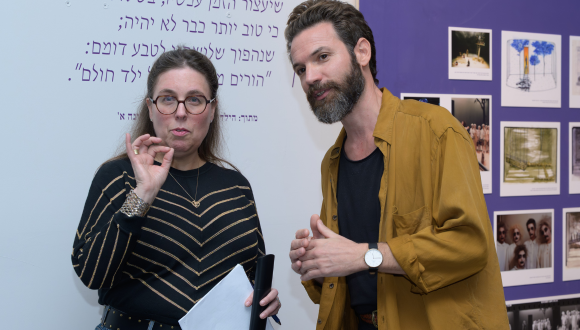
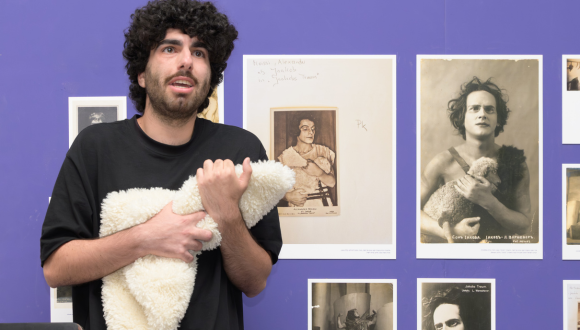
Prof. Sharon Aronson-Lehavi (on the left), associate professor of theatre and performance studies at the Department of Theatre Arts. (Photo credit: Tami Shaham)
A Shared Investigation: Why Dreams?
The topic “Dreams and dreaming in the theatre” was chosen as a guiding theme because theatre and dreaming share a powerful connection, both unfolding in the space between imagination and reality.
Dreams in the theatre are constructed through material, auditory, and visual elements, revealing how a culture imagines hope, fantasy, fear, or escape at a particular moment in time.
Like dreams themselves, performances are ephemeral, but archives offer a way back through sketches, notes, photographs, programs, and design materials that preserve the creative processes of vanished productions.
Three Plays, Three Perspectives on Theatre and History
To guide their research, the project teams selected three plays with rich archival documentation. Each one offered a distinct lens on how dreams intersect with history and imagination.
Together, these works trace a journey from older narrative traditions to contemporary realities, showing how dreamscapes help cultures navigate memory, identity, and survival.
-
A Midsummer Night’s Dream (Shakespeare, 1595/6)
The classic comedy allowed the teams to examine how both cultures adapt canonical works to reflect contemporary concerns. Israeli productions featured European theatre artists who arrived fleeing the Nazi regime: Julius Gellner, Paul Loewi, Gertrud Kraus, Teo Otto. Their artistic languages shaped the foundations of Israeli performance.
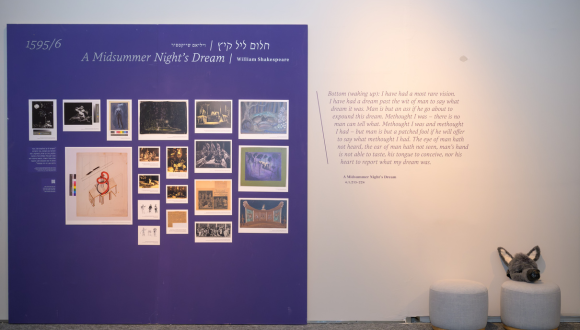
(Photo credit: Tami Shaham)
Juxtaposed with German postwar productions, the material shows how the same play becomes a mirror for different societies searching for escape, renewal, and fantasy.
-
Jacob’s Dream (Richard Beer-Hofmann, 1918)
Written in 1918, this biblical drama sits between tradition and modern history, following Jacob as he struggles to accept his destiny. It premiered in Vienna and Berlin, then appeared in Hebrew in 1925 in Moscow and Tel Aviv.
(Photo credit: Tami Shaham)
Students discovered how the play weaves together myth, personal crisis, and the emerging Zionist vision. The questions of political awakening and homeland echoed through both Israeli and German theatre communities a century ago and still resonate today.
-
The Child Dreams (Hanoch Levin, 1993)
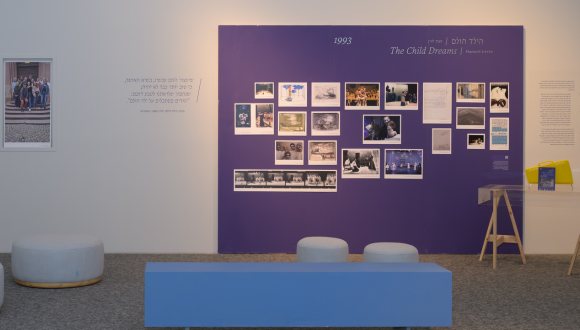
Written and directed by Hanoch Levin, with set design by Roni Toren, this poetic play explores displacement, cruelty, and the trauma of war through the eyes of a child.
(Photo credit: Tami Shaham)
Archival materials from the Israeli premiere and a Berlin production in 2023 show how the play crosses borders, offering a shared language for processing trauma and imagining compassion.
Between “Traum” and “Trauma”
By examining the three plays together, the students uncovered how dream imagery often surfaces in moments of historical rupture. The exhibition places these works in dialogue, revealing how dream sequences illuminate national anxieties, war, migration, and the search for hope. Together, they create an intercultural landscape that highlights both distinct theatrical traditions and shared artistic concerns.
During their archival research, the students identified an unexpected visual pattern: when designing dream-like spaces, artists in both Israel and Germany repeatedly turned to deep greens and purples.
This recurring palette served as the inspiration for the exhibition’s visual design, developed in collaboration with the Roni and Roni Studio.
A Collaborative Process Across Borders
The project began with a series of online meetings, where students from Tel Aviv University and the University of Cologne studied the plays together and shaped the curatorial principles for the exhibition. These early conversations laid the groundwork for a joint research language.
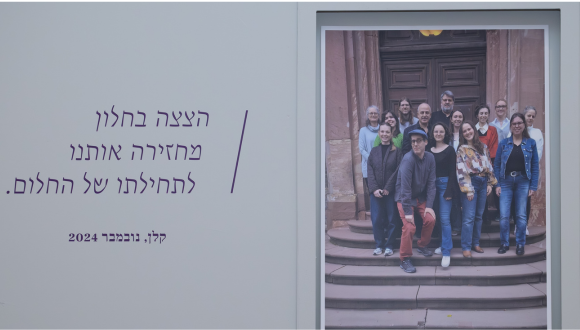
On study tour in Cologne (Photo credit: Tami Shaham)
A turning point came in November 2024, when the groups gathered in Cologne for a study tour and workshop at the Theaterwissenschaftliche Sammlung (TWS).
During this intensive week, they examined archival materials firsthand, visited major museums, and held critical discussions about how theatre history is curated and interpreted. It was in Cologne that the teams selected the objects now displayed in the exhibition.
Researching the Archives: Physical and Digital Worlds
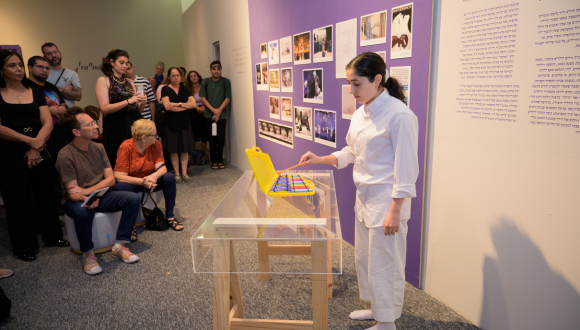
Students worked in mixed German–Israeli teams to locate, study, and interpret materials from several major institutions such as the TAU’s Israeli Center for the Documentation of Performing Arts, Theaterwissenschaftliche Sammlung (TWS), University of Cologne, the “Habima” National Theatre Archive, The Yehuda Gabai Theatre Archive, and the Akademie der Künste in Berlin
(Photo credit: Tami Shaham)
All items on display are facsimile reproductions. The exhibition also includes video documentation from The Child Dreams and student-created digital clips exploring new ways to engage with archival materials.
Visitor Resources for Research and Reflection
To expand the exhibition’s learning and exploration opportunities, the team produced archival binders, annotation cards, English-language catalogs, and QR codes linking to extended materials.
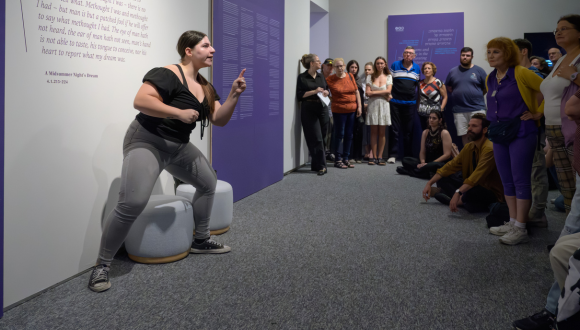
(Photo credit: Tami Shaham)
These tools invite visitors to experience the exhibition not only as observers, but as researchers.
Part of a Broader International Ecosystem
This exhibition joins a wider network of international theatre initiatives supported by the Lowy International School, including [six!], a global summer school in theatre studies led by six universities on five continents, among them TAU and the University of Cologne.
Like [six!], Dreams and Dreaming in the Theatre emphasizes collaborative learning, shared inquiry, and cross-cultural dialogue. Both projects show how international partnerships expand the study of theatre by bringing together diverse perspectives and creating learning communities that continue well beyond a single program.
Related Articles
![International Collaboration in Theater Studies at the [six!] Summer School in Chicago](https://international.tau.ac.il/sites/english.register.tau.ac.il/files/styles/research_teaser_image_180_x_180/public/six%20180.png?itok=uJ2RPwUm "International Collaboration in Theater Studies at the [six!] Summer School in Chicago")