Hebrew in China, Chinese in Israel
Language competitions backed by TAU sit at the heart of a deepening academic relationship between Israel and China.


Tel Aviv University supported two language competitions connecting Israel and China.
In Israel, students competed in Chinese at the Chinese Bridge final hosted at TAU.
In China, Hebrew learners took part in the Hebrew Language Olympiad co-organized by TAU.
Together, the contests reflect growing academic and cultural ties between the two countries.
In June 2026, Tel Aviv University stood at the center of a two-way language exchange between Israel and China.
At TAU, Israeli students competed in Chinese at the Israeli final of the 25th Chinese Bridge Chinese Proficiency Competition for Foreign College Students. In China, Hebrew learners took part in the 5th Hebrew Language Olympiad, an international competition co-organized by TAU.
Chinese Bridge Brings Israeli students of Chinese to TAU
On June 11, 2026, students from Tel Aviv University, the Hebrew University of Jerusalem, and the University of Haifa came to TAU to show their Chinese language skills. Participants competed in two groups: first-year Chinese majors and more advanced students.

Israeli participants of the Chinese Bridge competition at Tel Aviv University (Photo credit: Yael Zur)
The event was organized by the Confucius Institute at Tel Aviv University in close collaboration with the Embassy of China in Israel. Several TAU students entered this year’s competition, reflecting the university’s active role in Chinese language education in Israel.
Prof. Asaf Goldschmidt, Director of TAU’s Confucius Institute, welcomed the participants and jury, and acknowledged the work of Chinese language teachers across Israel. The event also featured a video address by Chinese Foreign Minister Wang Yi, recorded for the 2026 global event marking the International Day for Dialogue among Civilizations.
H.E. Ambassador of China Mr. Xiao Junzheng welcomed the students and reflected on the role of cultural exchange in a challenging world, describing Chinese Bridge as not only a language competition but a bridge of connection, mutual understanding, and dialogue among civilizations.
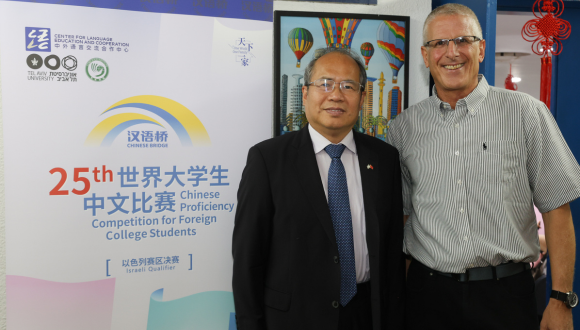
H.E. Ambassador of China Mr. Xiao Junzheng and Prof. Asaf Goldschmidt, Director of TAU’s Confucius Institute, at Tel Aviv University (Photo credit: Yael Zur)
The first round featured a short presentation in Chinese, letting participants show their fluency and confidence speaking the language in public. For Emily Cohen, a first-year participant from TAU, it was as much a test of nerve as of language.
"By participating in the competition, I proved to myself that I can step out of my comfort zone and do my best. I felt proud of my progress and of my ability to speak about things I am passionate about.—Emily Cohen, TAU
“Chinese and Asian studies are quite a niche field, and not many students choose it, so being able to compete alongside students from other universities in Israel who share the same interest felt very meaningful and fun."
For the second round, contestants prepared short performances connected to Chinese culture. The winner, Tomer Ben Shimol from the University of Haifa, demonstrated his skill in the traditional Chinese game of yo-yo.
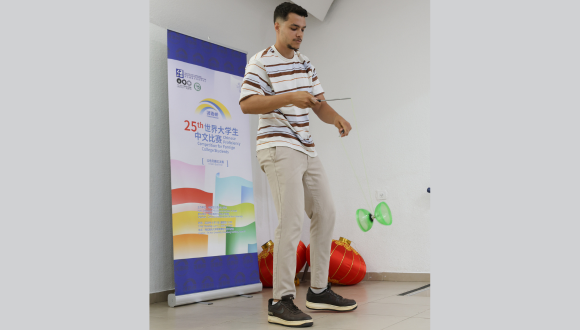
Tomer Ben Shimol (University of Haifa) learned the art of yo-yo as a child while living in China (Photo credit: Yael Zur)
Ofek Nagar from TAU performed a tea ceremony. He first took up Chinese out of a deepening interest in Chinese tea culture and has since grown enthusiastic about the country's ancient history, texts, and poetry. For Ofek, the talent round turned out to be where his Chinese flowed most freely:
"While I am used to talking about Chinese tea (even in Chinese, sometimes), I usually speak in front of a very small group of guests, and never in front of so many people. The funny thing is, some people came to compliment me on my unprepared little 'speech' while serving the tea."
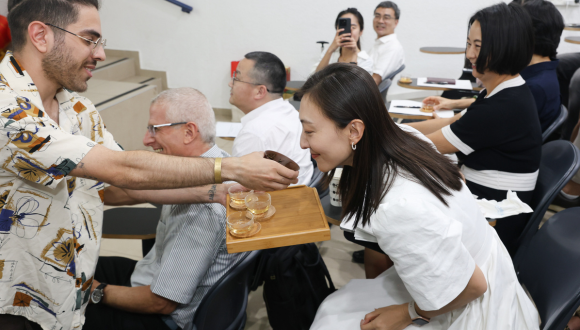
Ofek Nagar (TAU): "Turns out, my Chinese is more fluent when I serve tea at the same time!" (Photo credit: Yael Zur)
Liel Boev from TAU won the mini-competition among first-year students with a humorous speech about her childhood in Taipei and her stubborn refusal, back then, to learn Chinese: “The most challenging part of the competition for me was conveying a silly story from my childhood without knowing the nuances of humor in Chinese. Learning a language is one thing, but making people laugh in that language is another.”
“Although I succeeded in the end, and the judges loved my speech, I was most nervous about this part of the competition since I feel like this is something that can only be learned through integration in Chinese society; something I’m looking forward to.”—Liel Boev (TAU), Winner of the mini-competition.
Chinese Students Show Strong Results in Hebrew
While Israeli students were testing their Chinese at TAU, Hebrew learners in China were also taking part in a TAU-connected language competition of their own.
In June, TAU co-organized the finals of the 5th Hebrew Language Olympiad, jointly run with the Consortium for Hebrew Teaching and Culture at Brandeis University. This year, the olympiad has reached a record scale, drawing over 9,000 students from Israel and abroad, an increase of nearly 64% from last year. The international track included participants from the United States, China, Singapore, Brazil, the Netherlands, Egypt, Hong Kong, and Cyprus.

Chinese finalists of the Hebrew Language Olympiad at a reception at the Israeli Embassy in China
Chinese students had a significant presence in this year’s competition. A total of 25 Hebrew-major students from five universities in China participated in the first round, with eight advancing to the second round. For these students, Hebrew is a gateway to Israeli culture and traditions, and their turnout points to the language's growing appeal in China.
Ruiqi Che, a second-year student at Shanghai International Studies University who took third prize, came to Hebrew through a broader love of languages. What struck her was how the ancient and the modern sit together:
“Many familiar English names actually come from Hebrew: Michael, David, Sarah. After its revival, Hebrew also began absorbing English words and expressions. That combination makes learning it feel like opening a door to multiple cultures."
The hardest part, she says, has been speaking and listening, which are a common worry for anyone weighing whether Hebrew is hard to learn. "My classmate and I agreed to use Hebrew as much as possible when we chat. Since our levels are similar, we don't feel embarrassed even when we make mistakes."
Studying the language has also changed how she sees the country itself:
"After studying Hebrew, my understanding of Israel is no longer limited to seeing it as 'a country in the news'—I've begun to see its more everyday, vivid side."
“One word that stayed with me is צבר (tsabar), the cactus fruit: prickly on the outside, but sweet and soft inside. Israelis use it to describe themselves—they may seem tough or direct, but they're warm-hearted and value relationships deeply. It felt as though I suddenly understood something about the Israeli character."
Ruiqi Che hopes to continue her studies in Israel: "I look forward to studying abroad during my junior year, so I can truly immerse myself in a Hebrew-speaking environment and use the language more naturally and confidently."
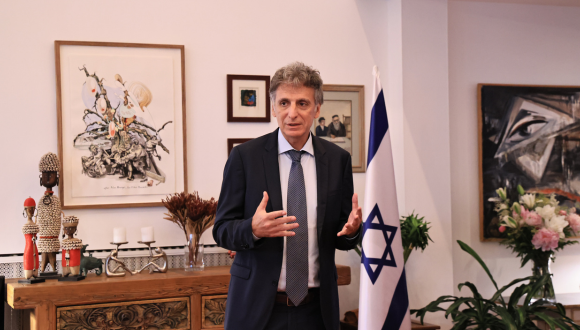
H.E. Ambassador of Israel to China Eli Belotsercovsky speaking to the Chinese finalists of the Hebrew Olympiad
Students’ achievements were recognized at a special award ceremony organized by the Embassy of Israel in China. H.E. Ambassador Eli Belotsercovsky attended, congratulating the winners, and later hosted participants and instructors for an Israeli-style dinner that made room for informal exchange around language and culture.
Curious about learning Hebrew? International students can study Hebrew in Tel Aviv through TAU's Intensive Hebrew Ulpan, summer and year-round, every level.
Language as Connection
The two competitions are a testament to a growing exchange between two different countries. In Israel, students of Chinese are engaging directly with one of the world's major languages and cultures. In China, Hebrew learners are using the language to access Israeli society, history, and academic life — the same draw that brings international students to study Hebrew in Israel firsthand.
For the Israeli students of Chinese, that connection often runs deeper than they expect. As one of the TAU participants put it:
"As a girl born and raised in Tel Aviv, I seemingly had no connection to the East apart from the tea I drink every morning. Yet it was only after I began my studies that I understood how strong this connection truly was."—Yali Siman Tov, TAU
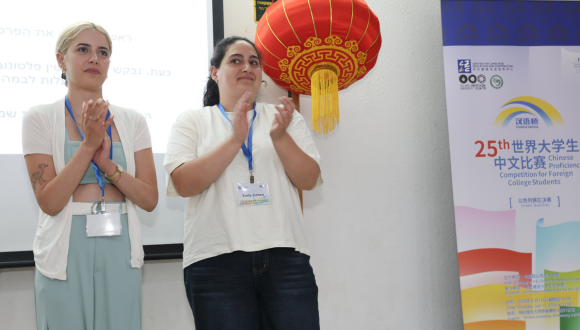
TAU participants of the Chinese Bridge competition, Yali Siman Tov and Emily Cohen (Photo credit: Yael Zur)
For Chinese students of Hebrew, the language opens a window onto everyday Israeli life. Ruiqi Che was struck by Shabbat:
"From Friday sunset to Saturday sunset, people put work aside. I admire this kind of 'forced shutdown.' In today's fast-paced world, having one fixed day to slow down, stop checking your phone, and simply enjoy meals and conversation is precious."—Ruiqi Che
“These details make me feel that language is not merely a tool; it conveys a way of life and a set of values," adds Ruiqi Che.
Language learning, after all, is not only about vocabulary, grammar, or public speaking. It is a way to enter another culture with greater precision, curiosity, and respect.
Tel Aviv University continues to strengthen its connections with Chinese universities and institutions, and these language competitions are one part of that effort. Through its Confucius Institute and ongoing academic collaborations, TAU is building lasting ties between the two countries.
Do you want to start Hebrew classes? Applications for Summer Ulpan at Tel Aviv University are now open.
FAQ
What is the Hebrew Language Olympiad?
The Hebrew Language Olympiad is an international Hebrew competition founded in 2021 by Tel Aviv University's Department of Hebrew and Semitic Languages. In 2024 it added an international track for non-native Hebrew learners; the 2026 edition drew over 9,000 participants from countries including the United States, China, Singapore, and the Netherlands.
Can international students learn Hebrew at Tel Aviv University?
Yes. TAU's Lowy International School runs intensive Hebrew Ulpan and other Hebrew language programs for international students, including summer and pre-degree tracks.
How can I study Hebrew in Israel?
You can study Hebrew in Israel through a university Ulpan. At Tel Aviv University, the Intensive Hebrew Ulpan offers structured courses for international students of all levels in Tel Aviv.
Related Articles