TAU PhD Student Wins Falling Walls Lab Tel Aviv 2026
Bar Shahar took first place with research into increasing cells’ own collagen production, earning a place at the Falling Walls Lab Global Finale in Berlin after researchers from six Israeli universities pitched ideas across science, health and technology.


Thirteen early-career researchers pitched at Falling Walls Lab Tel Aviv, each given three minutes.
Winner Bar Shahar is a PhD student at Tel Aviv University — see doctoral programs.
The lab was run by the Lowy International School with the DAAD and the German Embassy.
The winner advances to the global finals in Berlin on 9 November, the anniversary of the Berlin Wall's fall.
“What if, instead of extracting collagen from animals, we could encourage mammalian cells to produce much more of their own?”
That was the question Tel Aviv University PhD student Bar Shahar put to the jury at Falling Walls Lab Tel Aviv on September 9. In three minutes, she presented a new approach to increasing collagen production in mammalian cells. By the end of the competition, her pitch had taken first place.
Thirteen researchers from six Israeli universities and research institutions took the stage at Tel Aviv University. Their projects ranged from mapping shallow coastal waters from space and breeding earthworms for degraded soils to developing PFAS-free coatings and lower-cost bioreactors for cultivated meat.
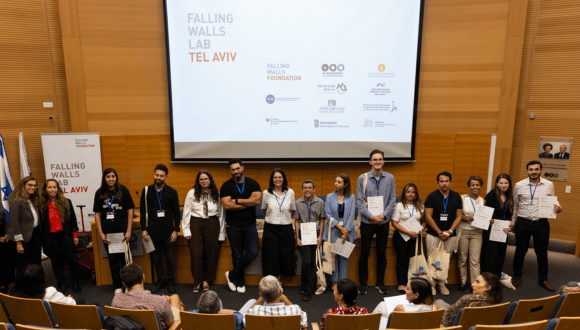
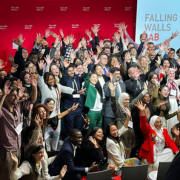
Participants of the Falling Walls Lab 2026 Tel Aviv (Photo credit: Dafna Talmon)
Thirteen researchers from six Israeli universities and research institutions took the stage at Tel Aviv University. Their projects ranged from mapping shallow coastal waters from space and breeding earthworms for degraded soils to developing PFAS-free coatings and lower-cost bioreactors for cultivated meat.
Falling Walls Lab is a global competition for students and early-career researchers and innovators. Pitches are judged on the breakthrough itself, its potential impact and how clearly the idea is communicated. As the Tel Aviv winner, Shahar will advance to the Falling Walls Lab Global Finale in Berlin on November 6.
What Does It Mean to Break a Wall?
The name Falling Walls traces back to the fall of the Berlin Wall on November 9, 1989, but the competition uses the idea of a wall more broadly to describe barriers that stand between a problem and a possible solution.
Opening the event, Dr. Evelyn Obele, Head of Scientific Affairs at the German Embassy in Tel Aviv, spoke about some of the less visible barriers that researchers encounter. These can exist between academic disciplines, between fundamental research and its practical applications, between institutions and generations of researchers, or within established ways of thinking that make familiar approaches seem fixed.
“Science, at its best, begins precisely where such assumptions are questioned.”—Dr. Evelyn Obele
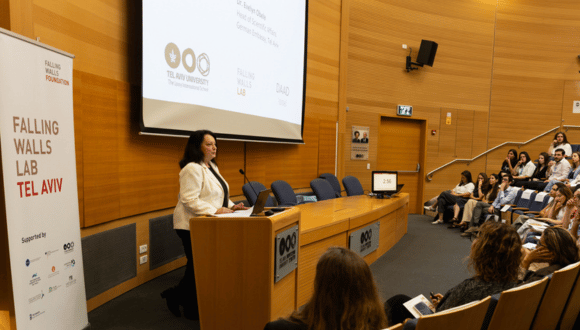
Dr. Evelyn Obele speaking at the Falling Walls Lab Tel Aviv (Photo credit: Dafna Talmon)
Assaf Bloom of the DAAD placed the event within a longer German–Israeli story, tracing scientific ties back to 1954, when a group of German scientists visited the Weizmann Institute.
"Holding the Falling Walls Lab here in Israel during the last three years of intense conflict and trauma is not to be taken for granted." — Assaf Bloom, DAAD
The idea of breaking less visible barriers carried directly into the pitches themselves, where several researchers focused on problems that remain hidden until their consequences become much harder to address.
Making the Invisible Visible
Across several of the pitches, the wall was one of visibility: important biological changes can go unnoticed until damage has already occurred.
Dr. Sandy Boutros-Suleiman (Bar-Ilan University) focused on distinguishing aggressive prostate cancers from tumors that may stay harmless for years.
"Some patients will go under unnecessary treatment, while aggressive disease may remain invisible." — Dr. Sandy Boutros-Suleiman, Bar-Ilan University
Her research examines biological signatures that could help identify patients at greater risk and eventually support less invasive testing and more personalized treatment.
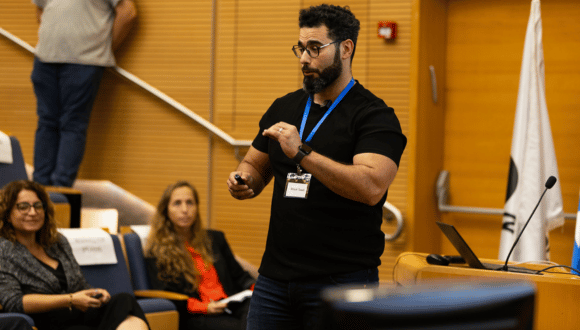
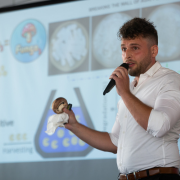
Shadi Tawil presented lower-cost bioreactors and sensing technology designed to make cultivated-meat production more affordable and easier to monitor. (Photo credit: Dafna Talmon)
Auri Menasheh (Tel Aviv University) put the stakes plainly, then proposed continuous sensing of blood flow, oxygenation and nerve function in the foot to detect changes before they develop into visible ulcers.
"Every 20 seconds, there's an amputation worldwide. In the three minutes I'm standing here, that is nine." — Auri Menasheh, Tel Aviv University
His system is designed to identify shifts from an individual patient’s normal patterns and alert patients, families and physicians early enough to intervene.
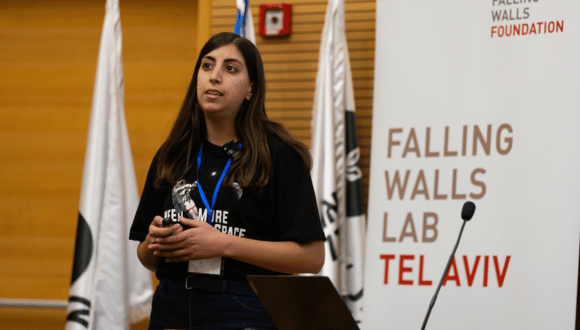
Noha Shalabny at the Falling Walls Lab Tel Aviv (Photo credit: Dafna Talmon)
And Noha Shalabny (Ben-Gurion) turned to astronauts, who lose 1 to 1.5% of bone density a month in space. Her research focuses on cellular stress triggered by the space environment, including microgravity, radiation, isolation and stress, and explores wearable biosensors and machine learning as a way to detect those changes before damage becomes apparent.
Other pitches addressed barriers beyond medical diagnostics. Dr. Manal Serhan (Bar-Ilan University) explored how digital learning tools could better support bilingual students and children with specific learning disorders, while Nadine Atika (Ben-Gurion University) presented a discreet safety device designed to help women experiencing domestic violence call for help and document dangerous situations
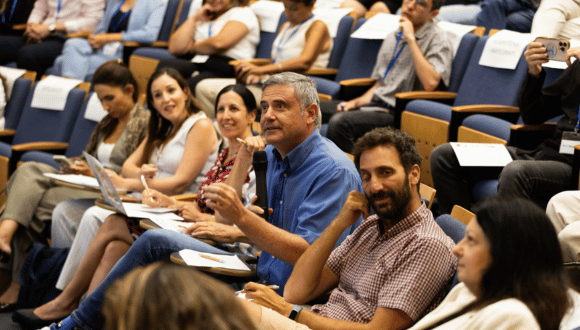
The jury of the Falling Walls Lab Tel Aviv: Dr. Galit Katarivas Levy (Ben-Gurion), Prof. Inbal Yahav (TAU), Prof. Zeev Zalevsky (Bar-Ilan), and Elik Almog (University of Haifa). (Photo credit: Dafna Talmon)
Turning Complex Research into a Clear Idea
The breadth of the research was matched by another challenge built into the Falling Walls format: participants had to make highly specialized work understandable to people beyond their own fields. In her opening remarks, Maureen Adiri Meyer, Director of the Lowy International School at Tel Aviv University, emphasized the value of giving emerging researchers experience presenting their work in English and bringing it before audiences outside their immediate academic circles.
“Doing research very often is the exact opposite skill set from coming and presenting it on a stage. It’s not easy to find the courage to go out there and to do something like this.” — Maureen Adiri Meyer, Director of the Lowy International School at Tel Aviv University
Several participants showed how an accessible image or a single question could make highly technical research immediately understandable.
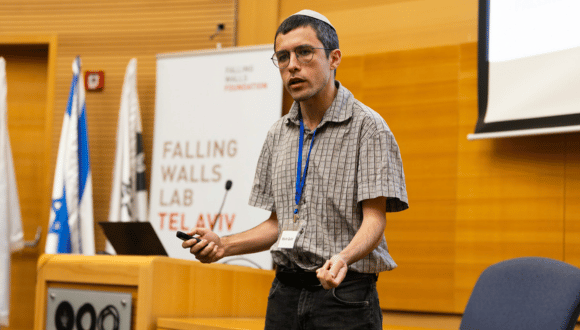
Maxim Quint (Hebrew University) proposed a breeding system that allows earthworms to effectively select themselves for traits that could help them survive in depleted, salty or drought-affected soils. (Photo credit: Dafna Talmon)
Mohammad Tibi (the Technion) formulated the challenge of neurological diagnosis as a simple contrast: “We can see the brain, but we can’t really read it.” His research combines molecular information from spinal fluid and blood with computational modelling to help determine where disease is occurring in the brain, with the goal of making diagnosis and monitoring earlier, more precise and more actionable.
Noam Ribak (Ben-Gurion University) framed her work around another direct idea:
"Women are still asked to adapt to the available solution, instead of designing the solution around the woman." — Noam Ribak, Ben-Gurion University
She presented a patient-specific, 3D-printed nipple-areola prosthesis for women following mastectomy, designed to reproduce individual anatomy, color and texture in a removable form.
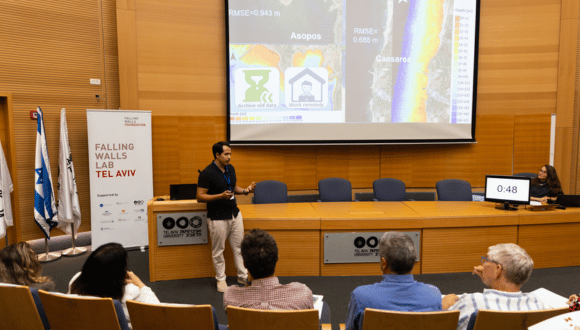
Gerardo Diaz presented satellite-derived bathymetry as a way to map shallow coastal waters remotely, potentially reducing the cost and logistical constraints of conventional surveying (Photo credit: Dafna Talmon)
Andrei Poliakov (Weizmann Institute of Science) took on the cost and complexity of groundwater detection. Existing systems can rely on powerful generators costing more than $100,000; his approach proposes a compact DC source, potentially as simple as a car battery, combined with an adaptive magnetometer that helps isolate the weak groundwater signal from electromagnetic noise.
"We want to turn groundwater exploration from an expensive lottery into an accessible and precise measurement." — Andrei Poliakov, Weizmann Institute of Science
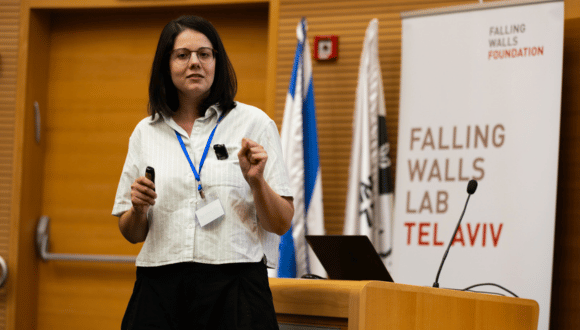
Mor Maayan (Hebrew University) pitched a modular superhydrophobic coating designed to maintain water-repellent performance without relying on PFAS chemicals. (Photo credit: Dafna Talmon)
For the winning pitch, the communication challenge was equally demanding: Bar Shahar had three minutes to explain how manipulating cells’ response to oxygen could open a new route to producing collagen.
A New Approach to Native Collagen Production
Collagen is the most abundant protein in the human body and is widely used in regenerative medicine, tissue engineering, cosmetics and drug delivery. Much of the collagen used today is derived from animal tissue, bringing challenges that can include variability, immune response and sustainability.
Shahar’s research starts with the way mammalian cells respond to low-oxygen conditions. Under hypoxia, cells increase collagen production. Her work explores whether that biological response can be activated without actually removing oxygen, encouraging cells to produce more of their own collagen.
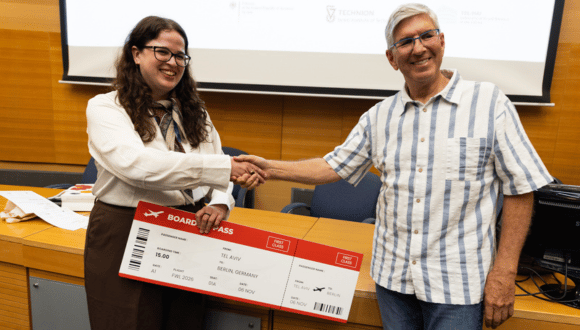
Bar Shahar, the winner of the Falling Walls Lab Tel Aviv, and Yair Sakov, Founder and Managing Director of the TAU Entrepreneurship Center and the member of the Falling Walls Lab jury (Photo credit: Dafna Talmon)
The research has already been published in a peer-reviewed study co-authored by Shahar and her TAU colleagues. The team found that inhibiting enzymes involved in cells’ response to oxygen could significantly increase collagen production under normal oxygen conditions.
Shahar will now take the research to the Falling Walls Lab Global Finale in Berlin, presenting it alongside emerging researchers from around the world.
Related Articles